
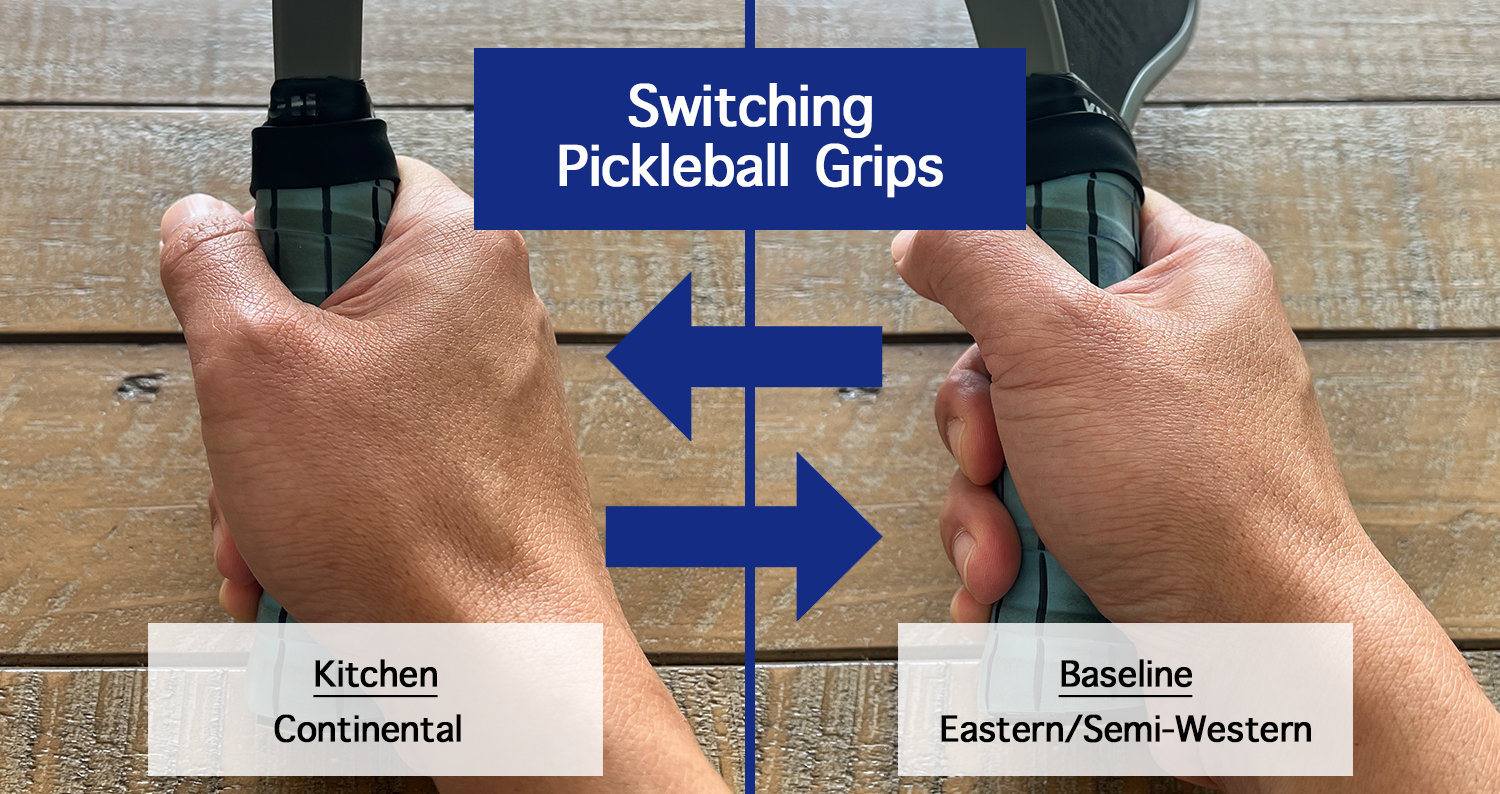
If you’ve ever felt like your drives have massive topspin from the baseline, but your volleys fly out of bounds at the kitchen, the culprit isn’t your swing—it’s your grip.
Grip switching is the deliberate, in-fingers rotation of your hand position on the handle as you move between court zones. Advanced players routinely transition between a closed grip for baseline power (Eastern or Semi-Western) and a neutral Continental grip for fast reflex volleys at the kitchen line.
Real-World Pro Example: Many touring pros start a point in a Semi-Western or strong Eastern grip at the baseline to load up on pace and heavy topspin. The moment they hit a third-shot drop and move forward, they seamlessly shift their hand back to a Continental grip to defend the kitchen line.
The Golden Rules of Grip Switching
-
Switch during the transition, not at the last split-second when the ball is arriving.
-
It is a subtle finger roll, not a heavy wrist twist or a full re-grip.
-
Keep the paddle up at a consistent ready height throughout the switch—never drop it to look at your hand.
-
Staying in a permanent Continental grip for everything is a completely valid simplification while building other fundamentals.
How to Switch: A Step-by-Step Guide
1. Hold Through Contact (Whole Hand)
Stay locked into your power grip (Eastern or Semi-Western) through the full stroke and follow-through of your baseline drive. Do not attempt to cheat the switch early, or you will mis-hit the ball.
2. Roll While Moving Forward (Fingers)
The moment the ball leaves your paddle and you start moving up the transition zone, execute the switch. Use your non-dominant hand lightly on the paddle throat to stabilize it while your dominant fingers roll the handle back to Bevel 2 (Continental).
3. Keep the Paddle Up (Paddle Height)
Maintain a chest-high ready position throughout your forward movement.
Note: Many players feel slow at switching simply because they drop the paddle to glance at their hand, not because the physical finger movement itself is slow.
4. Hold at the Kitchen (Whole Hand)
Stay anchored in your Continental grip for the dinking and volleying exchange. This positioning maximizes your backhand reflex block and lets you counter fast balls without needing to switch sides. If you are forced to retreat for another baseline drive, simply reverse the switch.
The Biomechanics: Why Fingers, Not Wrist
Grip switching is primarily a finger-dexterity skill, not a wrist movement.
-
The Finger Roll: The rotation happens through minute adjustments in finger pressure and micro-rotations around the handle bevels. Your wrist should stay largely still and stable.
-
The Wrist Trap: Players who try to switch grips by rotating at the wrist are forcing a slower, larger joint to do a job the much faster finger joints were built for. This is precisely why wrist-driven switches look and feel rushed, sloppy, and late.
Body Positions by Importance
| Body Part / Cue | Why It Matters | What Happens If It’s Wrong |
|---|---|---|
| 1. Fingers | Do the actual work of the switch through small pressure and rotation adjustments around the handle. | Relying on the wrist instead makes the whole switch slower, clunkier, and highly visible to opponents. |
| 2. Wrist | Should stay largely still and stabilized throughout a correct switch. | Wrist-driven switching works against a slower, larger joint, ruining your point-of-contact stability. |
| 3. Eyes | Must stay locked on the ball and your opponent throughout the entire transition. | Looking down to verify your grip change takes your eyes off the play at exactly the wrong millisecond. |
| 4. Paddle Height | Keeps the paddle at a consistent, dangerous ready height throughout the switch. | Dropping the paddle to “check” the grip costs significantly more time than the actual finger roll does. |
Common Mistakes & The Cost
Mistake: Switching too late, right as the ball approaches
-
Penalty: Forces a rushed, incomplete grip change right when precision and contact matter most.
-
Fix: Start the finger roll the exact moment you begin moving forward after your shot, not when you arrive at the line.
Mistake: Looking down at the paddle to verify the grip
-
Penalty: Blindfolds you to the opponent’s setup and takes your eyes off the ball.
-
Fix: Practice the switch by feel only. You can place a small strip of athletic tape or an elastic band on a specific handle bevel to check your grip by touch alone.
Mistake: Trying to find one “compromise” grip for everything
-
Penalty: Typically results in a grip that is mediocre at both baseline driving and kitchen dinking.
-
Fix: Commit to the switching habit for just two weeks of dedicated play before deciding whether or not it’s worth it for your game.
Frequently Asked Questions
Do pros actually switch grips during a single point?
Yes. This is incredibly well-documented among touring pros. Watching high-level tape reveals players constantly shifting from a heavy power grip at the baseline to a neutral Continental grip the second they transition to the NVZ (No-Volley Zone).
How long does it take to learn to switch grips smoothly?
The physical motion—the small finger roll—is usually learnable within a single, focused shadow-swing practice session. However, building the situational awareness and automatic timing typically takes several weeks of conscious gameplay before it becomes true muscle memory.
Is it fine to just stay in Continental for everything and skip switching?
Absolutely. Many recreational and even advanced-level players do exactly this. It is a completely reasonable and highly recommended simplification while you are still building other fundamental skills like footwork, paddle face control, and court positioning.
Next Posts
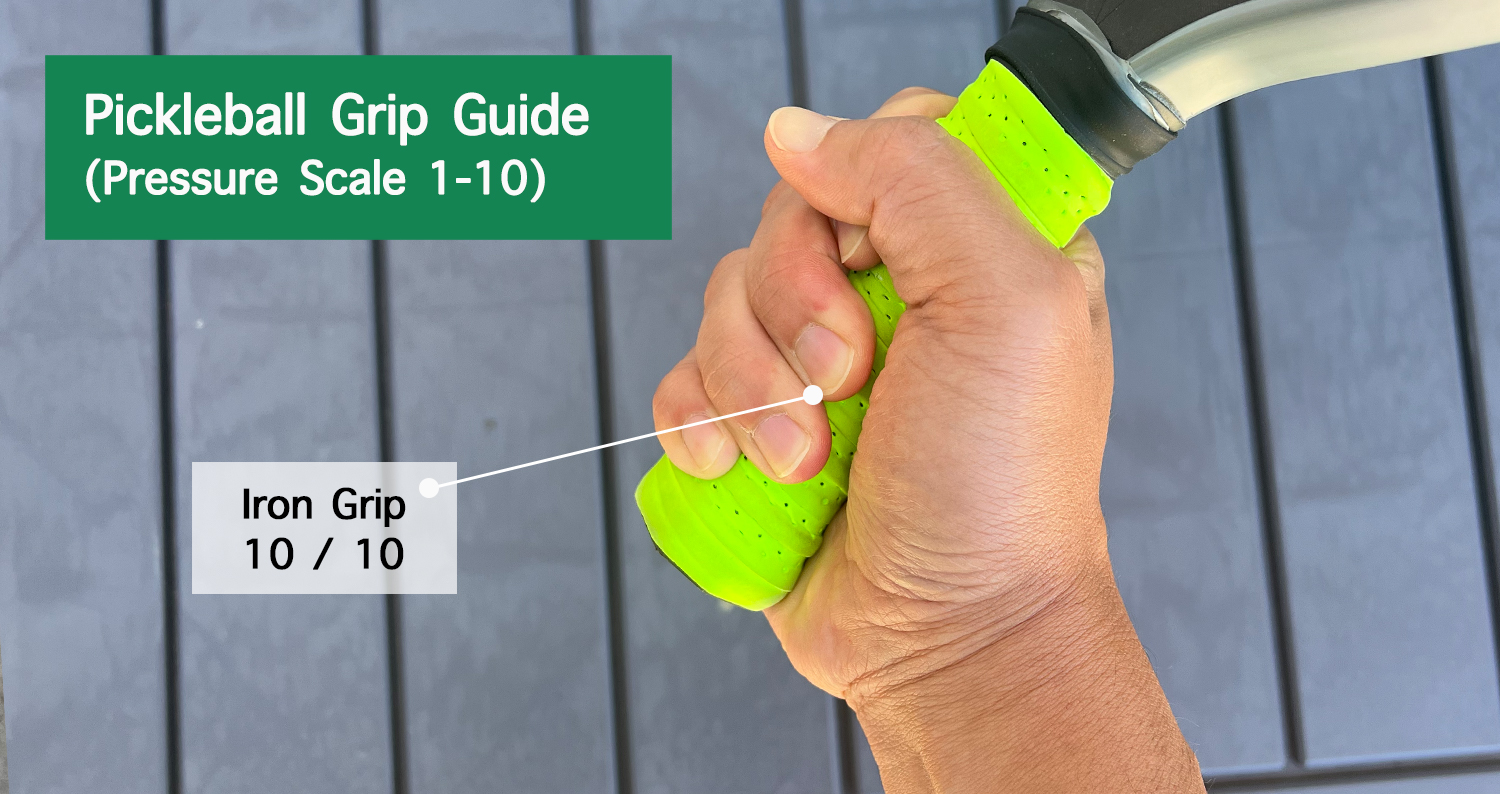
Pickleball Grip Pressure: The 1-to-10 Scale Explained
Pickleball grip pressure explained using the 1-to-10 scale coaches use — exact pressure targets by shot type and why tight grips cause pop-ups.
Pickleball Ready Position
Master the pickleball ready position — exact knee bend, foot width, and weight distribution that sets up every shot you'll ever hit.
Pickleball Paddle Height Ready Position
Where to hold your pickleball paddle between shots — the belly-button rule, why it minimizes coverage time, and how height changes at the kitchen.
continue reading
Related Posts
Pickleball sliding practice explained — how a controlled slide spreads deceleration force over distance instead of one hard stop, and how to train it off-court.
Wide stance deceleration in pickleball explained — why sudden stops stress the knees and ankles, and how a wider base distributes that force safely.
Pickleball lob footwork explained step by step — the pivot, drop step, and shuffle or crossover run that replaces backpedaling for any lob.