
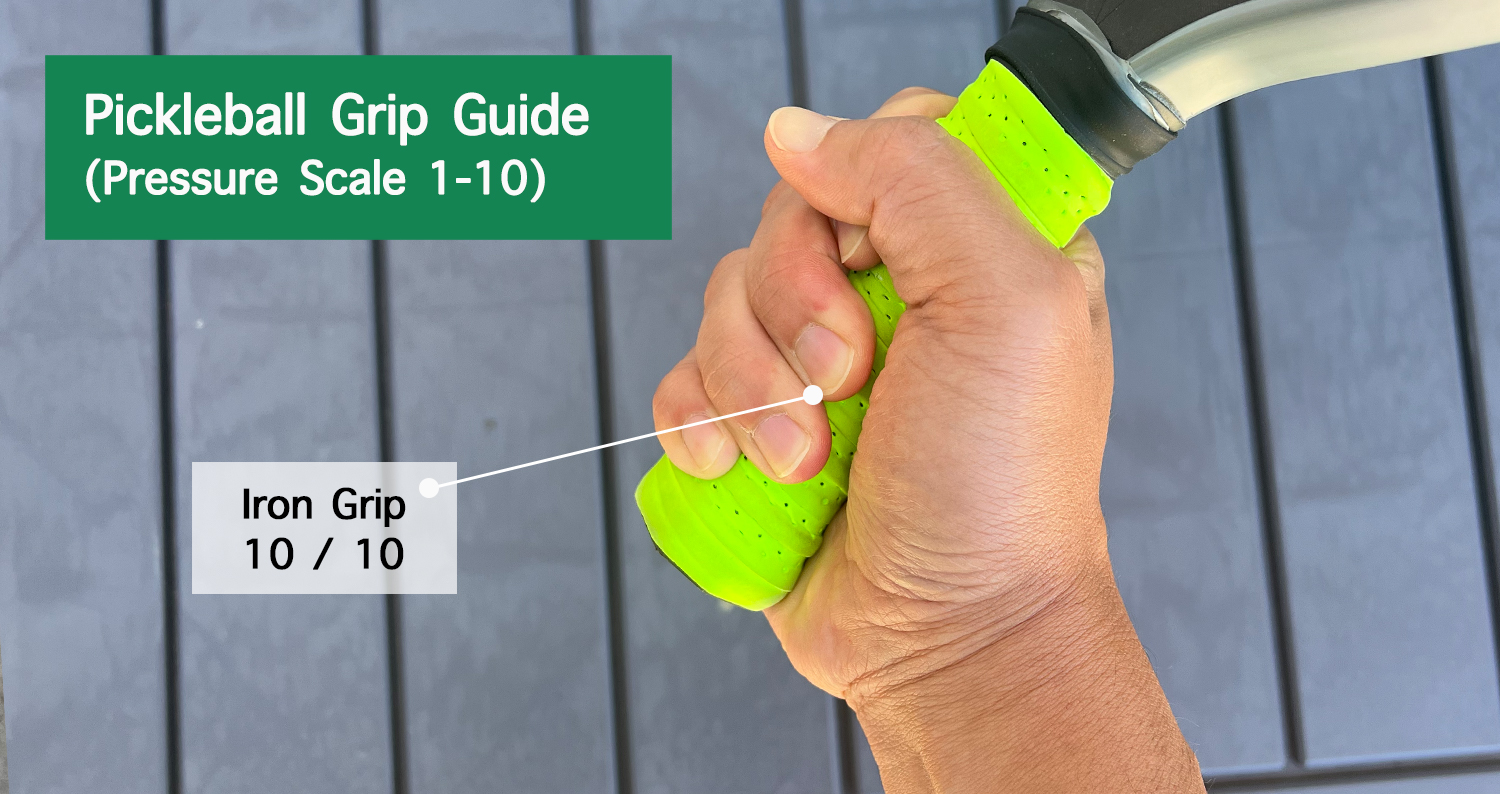
Every foundational guide covers grip type—which bevel your hand rotates to—and hand position on the handle. However, this final grip checkpoint is a completely separate variable: grip pressure.
Grip pressure is how hard you are actually squeezing the handle, independent of your hand position or which bevel you are on. To help players master this feel, elite coaches widely use a simple 1-to-10 scale.
What Exactly Is the Grip Pressure Scale?
The 1-to-10 scale is a visual and physical spectrum used to calibrate your hand strength during a rally:
-
1 out of 10: You are barely holding the paddle, like cradling a delicate bird. The paddle could almost slip out of your hand.
-
10 out of 10: A white-knuckle “death grip” with visible tendons straining in your forearm.
💡 Crucial Concept
A tight grip transfers energy back into the ball on contact; a loose grip absorbs it. This isn’t just a metaphor—it is the literal physics behind why a “death grip” causes frustrating pop-ups and long balls on shots that were supposed to be soft.
Quick Summary
-
The Scale: 1 (barely holding) to 10 (white-knuckle death grip).
-
The Baseline: Dinks and soft drops sit low (3–4 or 2–5), while drives and fast volleys sit higher (7–8).
-
Never hit a 10: No pro coach recommends a maximum death grip. If your knuckles are white, your grip is too tight.
-
The Misconception: “Soft hands” means low grip pressure—it does not mean a loose, floppy wrist. Your wrist should stay stable while your fingers and palm relax.
-
The Goal: Dynamic pressure. Your grip must change shot-to-shot, rather than remaining locked at one number for the entire rally.
How to Calibrate It: The Step-by-Step Guide
Before you can adjust your pressure mid-rally, you need to know what your boundaries feel like. Use this step-by-step scan to calibrate your hands:
-
Find Your Zero [Hand]: Hold the paddle loose enough that it feels like it might slide out of your palm. This is your baseline for the bottom of the scale.
-
Find Your Ten [Hand]: Squeeze the handle as hard as you humanly can until your knuckles turn pale. This is your absolute ceiling—and a level of tension that causes rapid muscle fatigue and tennis elbow.
-
Set Pressure Before the Shot, Not During It [Hand]: Anticipate your target pressure based on the shot you are about to hit (dink vs. drive) before the ball arrives, rather than panic-squeezing as a last-millisecond reaction.
-
Keep the Wrist Separate From Grip Pressure [Wrist]: Consciously drop your grip pressure in your palm while keeping your wrist joint stable. Your arm’s movement should still smoothly originate from the shoulder or legs, not from a floppy wrist.
The Biomechanics: Why Loose Absorbs and Tight Repels
The physics of a pickleball paddle collision boil down to energy transfer. When a fast-moving ball hits a tightly gripped paddle, the paddle acts like a solid brick wall. The energy has nowhere to dissipate, causing the ball to bounce violently back off the face—flying deep past the baseline or sky-high into an easily smashable pop-up.
Conversely, a looser grip acts like a shock absorber. It allows the paddle face to give slightly at contact, taking pace off the incoming ball and keeping it on the face a fraction of a second longer. This micro-delay gives you maximum touch and sensitivity.
Under pressure, tightening up when a ball comes fast is a natural human stress response. However, on the pickleball court, it is the exact opposite of what a soft reset requires.
The Exception: Why Drives Want a Firmer Grip
If loose hands give you so much control, why ever tighten your grip?
The loose-absorbs-tight-repels principle applies specifically to managing your opponent’s incoming pace (defensive blocks, resets, and neutral dinks). Drives and put-aways are offensive.
When you hit a drive, the pace at contact is energy you are actively generating, not energy you are trying to absorb. A firmer grip (roughly 7–8 on the scale) keeps the paddle face completely stable. It prevents the paddle from twisting or wobbling in your hand at the exact millisecond you transfer your body’s kinetic energy into the ball, ensuring a clean, square, and powerful strike.
Common Mistakes & The Cost
| The Mistake | The Penalty | The Fix |
|---|---|---|
|
Static Grip Pressure Holding the same pressure for every shot, all match long. |
Causes deep balls to sail long and dinks to pop up over the net. | Consciously vary pressure—lower (3-4) for soft kitchen play, higher (7-8) for baseline drives. |
|
Confusing Soft Hands with a Loose Wrist Letting the wrist flop around wildly on touch shots. |
Creates extreme instability, leading to sprayed balls, mis-hits, and poor repeatability. | Keep the wrist firm; let your fingers and palm carry the reduced pressure while the arm swings from the shoulder. |
|
Panic Squeezing Squeezing tighter as the incoming ball gets faster. |
Transmits all the opponent’s power directly back into the ball, ruining resets and blocks. | Use the non-dominant hand tool: Relax and support the paddle with your non-dominant hand between points to reset your physical tension. |
|
Choking Up Too High Creeping your hand all the way up to the paddle face. |
Sacrifices reach, leverage, and power on baseline strokes. | Position your index finger 1–2 inches from the throat, keeping it slightly separated from the other fingers for stability. |
Pro Drills to Build Muscle Memory
-
The Finger-Only Rally: During warm-ups, practice forehand dinks using only your thumb, index, and middle fingers on the handle. This forces your hand to drop tension, highlighting how the shoulder handles the stroke while your fingers provide just enough touch to keep the ball low.
-
The Towel-Twist Drill: Twist a towel like you are wringing out water, hold that maximum tension for 10 seconds, and release. This builds muscle awareness of what a 10 feels like so you can consciously avoid it on court.
-
The Post-Match Forearm Check: If your forearms or elbows feel excessively tired or sore after a session, you are chronic over-gripping. Use your non-dominant hand to cradle the paddle between points to break the fatigue cycle.
Frequently Asked Questions
What grip pressure should I use for a dink or drop shot?
Coaches universally recommend staying on the low end of the scale for finesse shots—commonly cited sweet spots fall between 3 and 4 (or up to a 5). It should feel noticeably looser and softer than what feels natural to a beginner.
What grip pressure should I use for a hard drive or reset?
For offensive drives and fast volleys, aim for a 7 or 8. Even on power shots, you should never hit a full 10. A 9–10 “death grip” completely locks up your arm mechanics and strips away your accuracy.
Does soft hands mean my wrist should be loose too?
No. This is the single most common point of confusion in pickleball. “Soft hands” refers exclusively to the relaxed state of your fingers and palm. Your wrist joint should remain relatively firm and stable so that your mechanics stay clean and repeatable.
Why does a drive need a firmer grip if loose hands give more control?
Loose hands excel when you are absorbing an opponent’s pace (like a block at the kitchen line). A drive is the exact opposite—you are creating the pace yourself. A firmer grip (7–8) prevents the paddle from twisting out of square when it collides with the ball at high speeds.
Next Posts
Pickleball Ready Position
Master the pickleball ready position — exact knee bend, foot width, and weight distribution that sets up every shot you'll ever hit.
Pickleball Paddle Height Ready Position
Where to hold your pickleball paddle between shots — the belly-button rule, why it minimizes coverage time, and how height changes at the kitchen.
The Pickleball Split Step
The pickleball split step explained — exact timing relative to your opponent's contact, the mechanics, and why most players get the timing wrong.
continue reading
Related Posts
Pickleball sliding practice explained — how a controlled slide spreads deceleration force over distance instead of one hard stop, and how to train it off-court.
Wide stance deceleration in pickleball explained — why sudden stops stress the knees and ankles, and how a wider base distributes that force safely.
Pickleball lob footwork explained step by step — the pivot, drop step, and shuffle or crossover run that replaces backpedaling for any lob.