
If you’ve ever watched a tennis player step deeply into a classic groundstroke, you’ve seen the closed stance in action. In pickleball, this traditional footwork pattern is one of your most potent tools for injecting raw, heavy pace into your drives.
However, because pickleball is a game played on a tiny court with rapid-fire exchanges, this high-power stance comes with a steep recovery tax.
Here is exactly what a closed stance is, how to execute it through the kinetic chain, and when you should—and shouldn’t—use it on the court.
What Exactly Is a Closed Stance?
A closed stance positions your feet and hips perpendicular to the net. If you are right-handed, your left shoulder (non-paddle shoulder) points directly toward the net, turning your body completely sideways to the direction of the incoming ball.
This stance is the ultimate execution of the “unit turn.” It represents the most committed version of the turn-pause-step-swing sequence, utilizing forward linear momentum rather than just lateral rotational torque.
💡 Crucial Concept
The closed stance forces full-body rotation. You physically cannot generate a clean drive from this stance using only your arm. The mechanical positioning itself demands that your legs, hips, and core do the heavy lifting, preventing you from “cheating” with an arm-only swing.
Quick Summary
-
The Setup: Feet and hips perpendicular to the net; non-paddle shoulder points at your target.
-
Best For: Hard baseline drives, third-shot power drives, and deep driving serves.
-
Pro-Tip for Beginners: Excellent for learning how to utilize a proper unit turn, as it naturally locks out arm-dominant errors.
-
The Downside: Requires an extra recovery step to get back into position. Never use it during fast kitchen transitions.
How to Set It Up
[1. Turn Shoulders] ➔ [2. Set Perpendicular Feet] ➔ [3. Load Back Leg] ➔ [4. Drive Forward]
-
Turn Your Shoulders (The Trigger): Before the ball even bounces, rotate your torso so your non-paddle shoulder points at the net. This is your primary visual marker.
-
Set Your Feet: Position your feet perpendicular to the net, pointing toward the sideline rather than square to the court.
-
Load the Back Leg: Lower your center of gravity slightly and bend your back knee to load your weight onto your trailing leg. Note: Avoid bending too low (squatting), which traps your weight on your heels; keep it crisp and springy.
-
Drive Through the Ball: Push explosively off your back leg, transferring your body weight forward onto your front leg as your hips and shoulders uncoil together through contact.
The Biomechanics: Power vs. Recovery
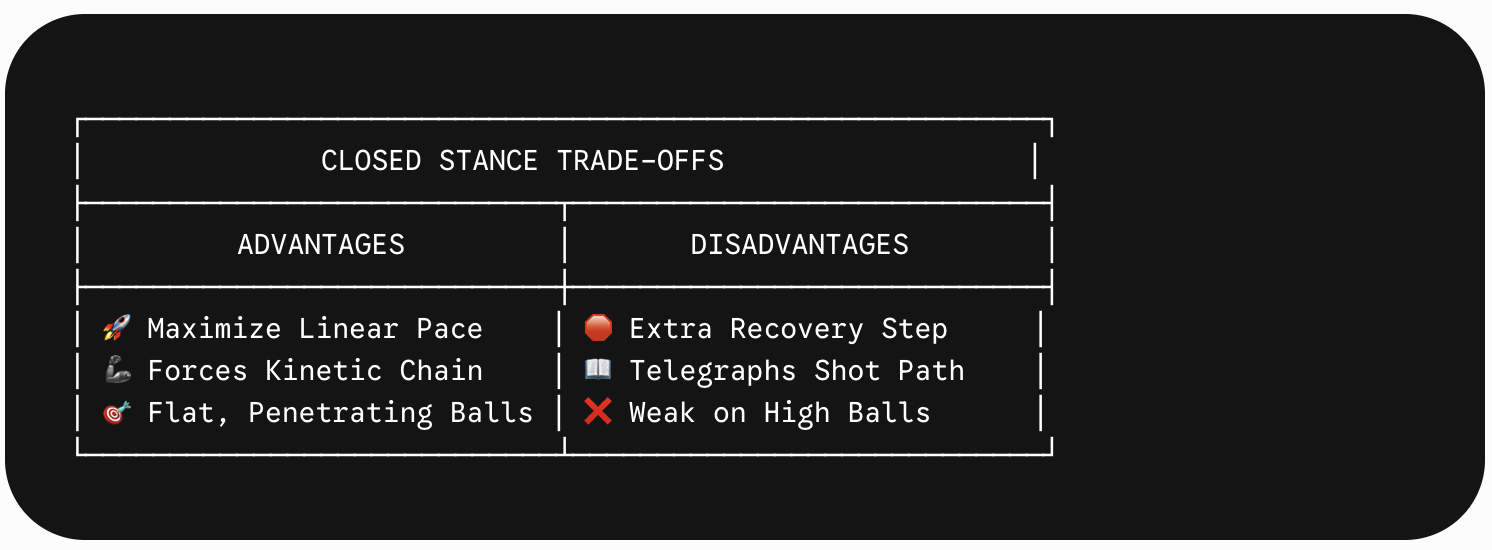
The closed stance is a masterclass in linear power transfer. By stepping into the court, your forward momentum combines with your core rotation to deliver a flat, blistering ball trajectory (think of big-hitting pros like Dekel Bar).
However, this mechanical setup requires a clear cost-benefit analysis:
-
The Telegraphing Problem: Because your hips are locked sideways, a closed stance naturally limits your angles. It is mechanically difficult to disguise your intent, meaning your shots will naturally travel in the direction your body is pointing, making it easy for an attentive defender to read.
-
The Recovery Tax: To move freely after a closed-stance hit, your body must completely un-rotate and square back up to the net. This takes a microsecond longer than an open or semi-open stance—a delay that can be fatal in pickleball.
Body Positions by Importance
| Body Part | Why It Matters | What Happens If It’s Wrong |
|---|---|---|
| 1. Shoulders | The non-paddle shoulder pointing at the net triggers full-body rotation and initiates the unit turn. | Failing to turn the shoulders kills the kinetic chain, reducing your stroke to an unstable arm-swing. |
| 2. Back Leg / Knee | Acts as the launchpad; a slight bend loads the linear weight transfer. | No load means no forward power source, forcing you to reach and slap at the ball. |
| 3. Feet | Perpendicular alignment physically blocks you from opening up too early. | Feet drifting square mid-setup creates a messy, accidental open stance with no stability. |
| 4. Hips | Must rotate locked in tandem with the shoulders through the ball contact point. | Hips opening too early leaks your power and severely causes mishits or spray balls. |
Common Mistakes & The Cost
1. Using a Closed Stance During Fast Kitchen Exchanges
-
The Penalty: The extra recovery step needed to clear your hips leaves you completely exposed to a rapid-fire counter-attack.
-
The Fix: Stay in an Open Stance (hips and chest square to the net) or Semi-Open Stance at the Non-Volley Zone line for maximum lateral agility and instant paddle readiness.
2. Staying “Square” to the Net While Trying to Hit a Closed Drive
-
The Penalty: Absolute loss of power and depth consistency. Shots tend to float or drift wide because your body isn’t actually rotating.
-
The Fix: Commit to the shoulder turn fully. A half-hearted closed stance gives you all the footwork sluggishness without any of the power payoffs.
3. Relying on It Exclusively from the Baseline
-
The Penalty: Attentive opponents will park crosscourt or down-the-line because your locked hips completely give away your target.
-
The Fix: Mix in a semi-open stance to hide your intentions and give yourself the freedom to pull the ball crosscourt.
Frequently Asked Questions
Is a closed stance good for pickleball beginners?
Yes, highly recommended—but specifically for drills and practice. Because a closed stance physically forces you to rotate your upper body, it is one of the fastest ways to teach a beginner how to hit with their core instead of “muscling” the ball with their arm.
Should I use a closed stance when serving?
Absolutely. Many power-hitting players prefer a closed or semi-closed stance on the serve. It allows you to take a clean step into the baseline, converting your forward body weight into effortless velocity.
Why does my closed-stance drive feel powerful but get intercepted easily?
You are experiencing the textbook trade-off of the closed stance: high output, low disguise. Your opponent is reading your shoulders and hips, which naturally point right along the trajectory of your target. To fix this, practice delaying your swing or shifting to a semi-open stance to keep them guessing.
Next Posts
How to Choose Your Pickleball Stance in Real Time
How to choose your pickleball stance mid-point — using ball depth, available time, and your next move to pick closed, semi-open, or open instantly.
The Unit Turn in Pickleball
The pickleball unit turn explained — rotating hips, shoulders, and non-paddle arm together as one unit, with the exact turn-pause-step-swing sequence.
Pickleball Kinetic Chain
The pickleball kinetic chain explained — the legs-to-paddle power sequence that separates effortless drives from arm-only swinging.
continue reading
Related Posts
Pickleball sliding practice explained — how a controlled slide spreads deceleration force over distance instead of one hard stop, and how to train it off-court.
Wide stance deceleration in pickleball explained — why sudden stops stress the knees and ankles, and how a wider base distributes that force safely.
Pickleball lob footwork explained step by step — the pivot, drop step, and shuffle or crossover run that replaces backpedaling for any lob.