
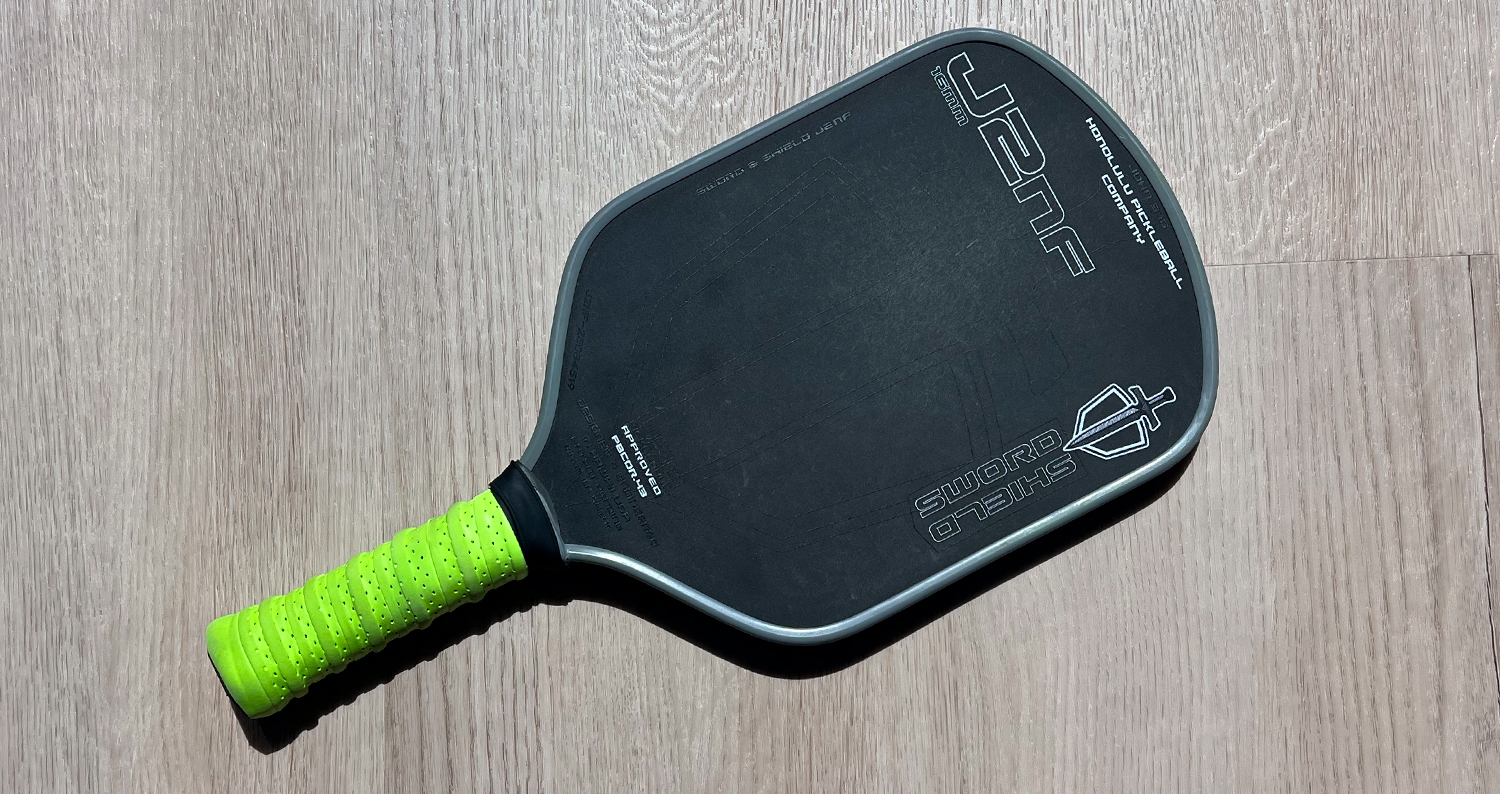
I’ve been playing with the Honolulu Pickleball Company J2NF paddle for about 9 months now. I hit the courts around 3 times a week, so it has taken a massive amount of abuse. This was my very first foam-core paddle. After putting nearly a year of hard mileage on it, I wanted to combine my experience with what the wider pickleball community and prominent reviewers (like Pickleball Studio and Pickleheads) are saying.
If you are trying to cut through the hype and figure out if this paddle is actually worth your money, here is the honest truth.
Deciphering the Confusing Name
If you look at Honolulu’s website, their naming scheme looks like alphabet soup. Honolulu is notorious for throwing everything at the wall to see what sticks when it comes to paddle releases, and they currently offer a ton of similar models that completely confuse people. To save you some head-scratching, here is the quick breakdown of how their system works:
-
J2 = The shape. J2 means it’s a hybrid shape (curved top corners), J7 is elongated, and J3 is widebody.
-
NF = Notched Foam. This is their newer interlocking core design where the inner core and outer edge foam interlock like little gears for maximum stability.
-
FC+ = A slightly different model using a traditional Gen 3-style outer foam ring instead of the interlocking notched design.
-
K or T = The face material. K is Kevlar, T is polyester.
My advice? Don’t overthink it or get bogged down by the variant options. Stick to the standard J2NF Gen 4.5. It features a composite face that sandwiches a full layer of fiberglass between two layers of raw carbon fiber. That fiberglass layer is what gives the paddle its explosive, reactive pop during fast hands exchanges.
Specs at a Glance
Before diving into the playability, here are the core technical specifications that define how the J2NF performs:
-
Dimensions: 16.2″ Length × 7.8″ Width (Aero Hybrid Plus shape)
-
Core: 16mm Multi-Density Notched Foam (EPP center interlocked with EVA perimeter)
-
Weight: 8.0 – 8.3 oz (Midweight)
-
Swing Weight: 110 – 114 (Highly maneuverable; fast hand speed)
-
Twist Weight: 7.0 (High stability and twist resistance on off-center hits)
-
Handle Options: 5.5″ (Standard) or 6.0″ (Extended LH version) with a 4.125″ circumference
First Impressions & Getting Used to Foam
Out of the box, the balance feels great. The stock swing weight sits right around 111, meaning it is highly maneuverable and fast at the kitchen line compared to head-heavy power paddles.
However, because it was my first foam paddle, it actually took me a solid two weeks of consistent play to get used to it. The feedback off the face just feels entirely different than a traditional plastic honeycomb core. It’s a different dynamic entirely, so don’t expect to love it on your first game. Give your muscle memory a couple of weeks to adapt to the touch. Once you adjust, it completely clicks.
Real-World Durability & Neglect: 9 Months In
To be completely honest, I am not someone who takes good care of my paddles. I don’t clean the face, I don’t use an eraser, and I just throw it in my bag when I’m done. That said, I’m also not someone who smashes my paddle on the ground in frustration. These pictures below were taken after 9 months of consistent use playing approximately 3 times weekly.
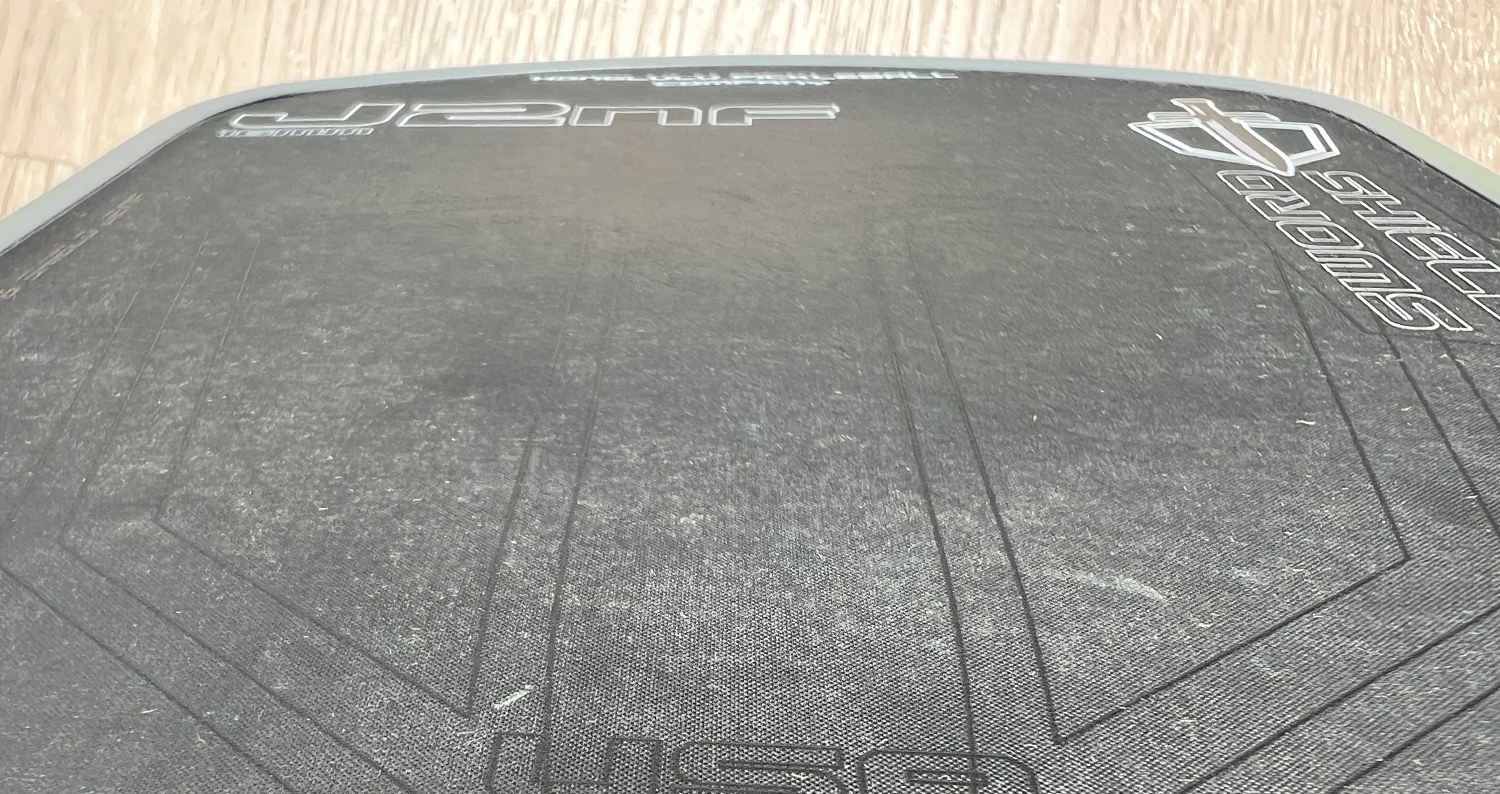
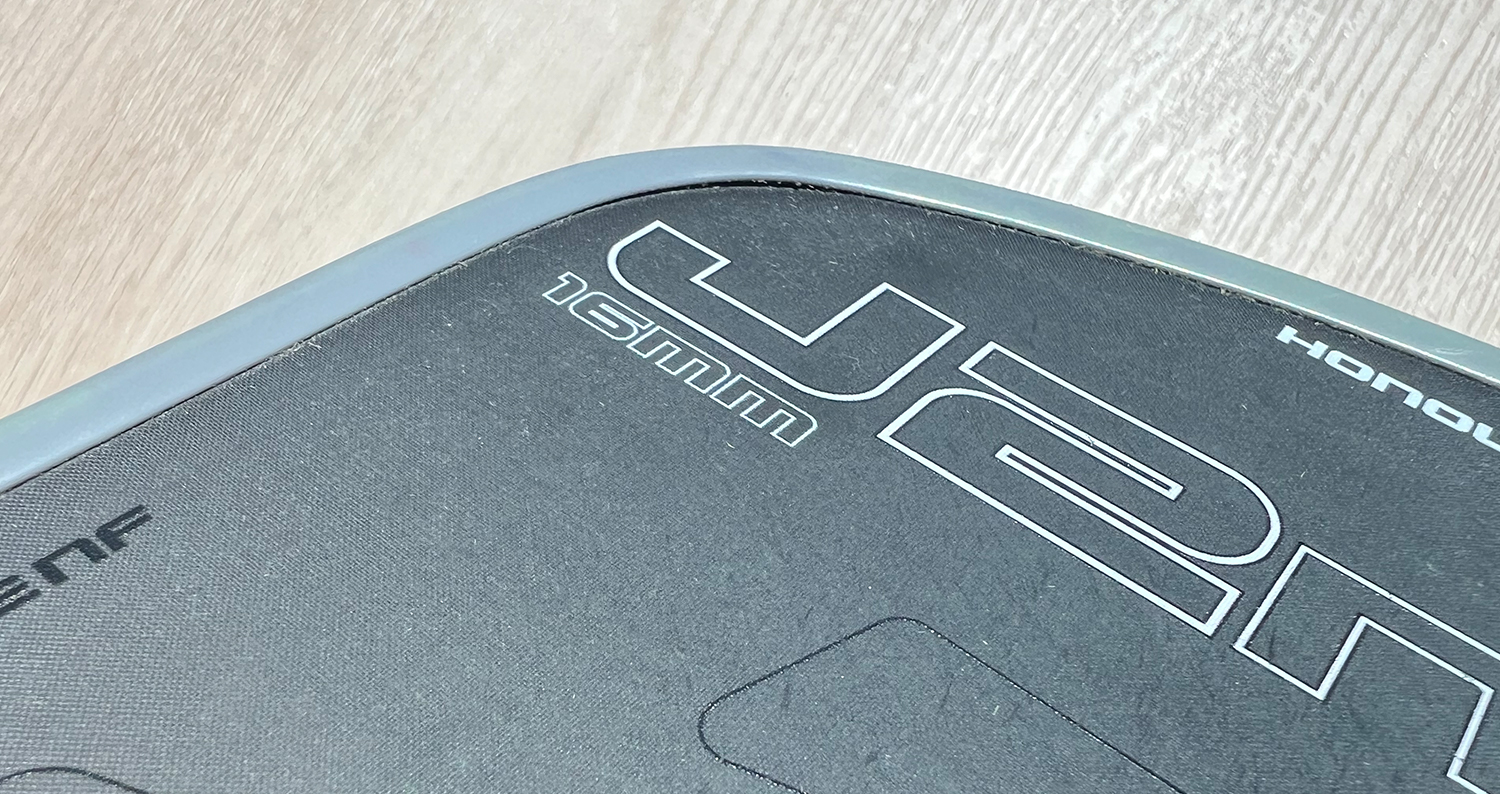
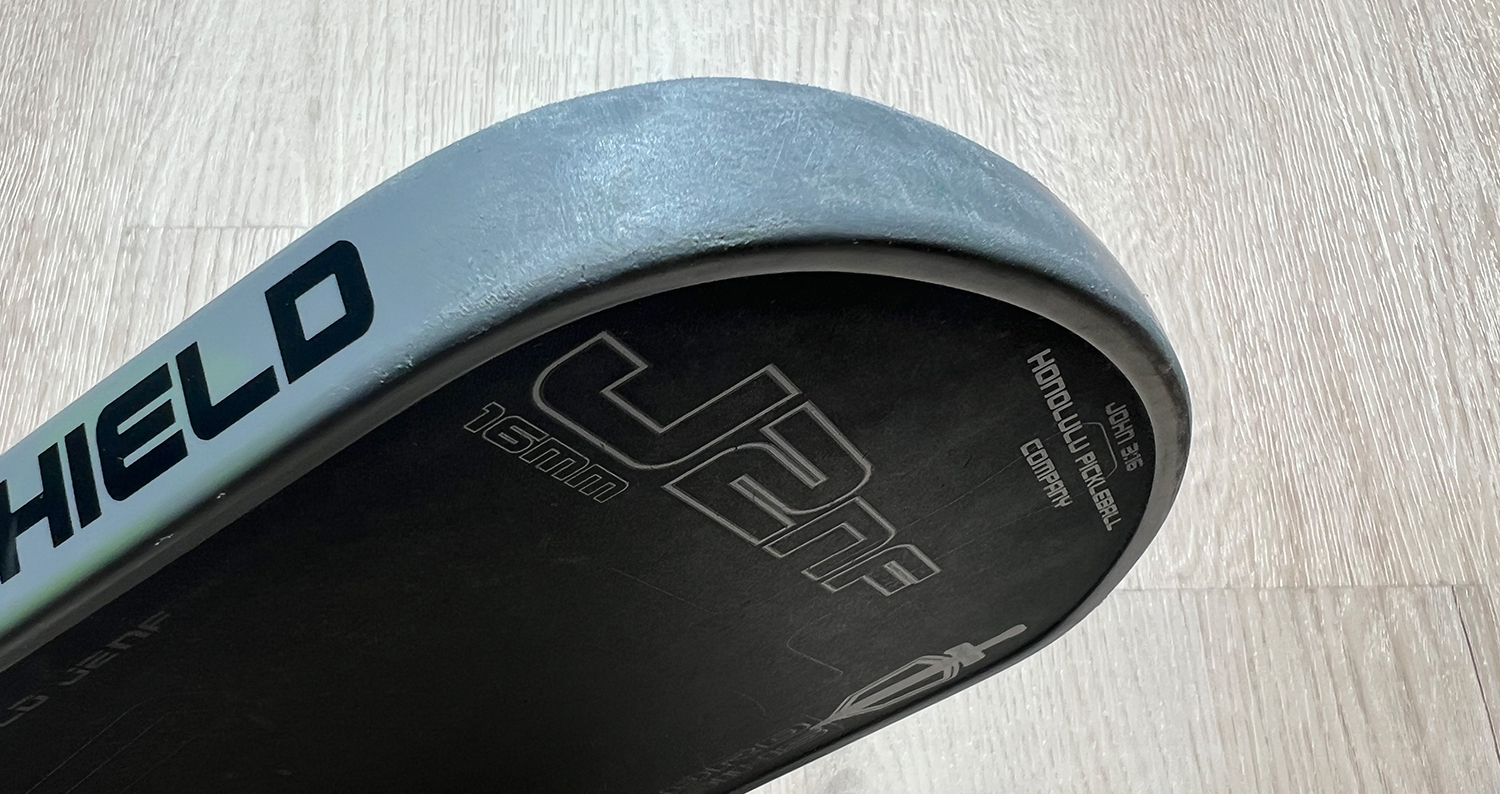
Even with 9 months of constant play and absolute zero maintenance, the J2NF is built like a tank. My older generation honeycomb paddles always seemed to break down or get soft right along the edge guards under this kind of treatment. By comparison:
-
The Face & Core: Despite never cleaning it, the face texture comes surprisingly rough from the factory, and the grit is holding up incredibly well with zero drop-off in spin. There are absolutely no dead spots or uneven surfaces when I run my hand across it.
-
The Edge Guard: The guard along the sides is still locked down super tight. The factory glued it down exceptionally well, so it isn’t buzzing, rattling, or separating despite my lack of upkeep.
How it Plays & That Massive Sweet Spot
The absolute superpower of the J2NF is the sweet spot. Compared to almost every other paddle I’ve tried, it feels oversized for a hybrid shape. Because of that interlocking notched foam perimeter, you get crazy amounts of forgiveness. If you are late to a ball and reaching, off-center contact still travels on a reliable line with decent depth instead of twisting the paddle out of your hand or dying on the face. It keeps you in rallies you have no business winning.
Performance-wise, it sits beautifully in the aggressive all-court category. It has plenty of punch for overheads and drives. Thanks to the aggressive face texture, it easily generates elite topspin (regularly clocking over 2,100 RPM in industry tests) to dip your drives safely inside the baseline.
Handle Lengths: 5.5″ vs 6″
One of the best updates to the Gen 4.5 lineup is that Honolulu gives you actual choices for handle lengths.
-
Standard 5.5″ handle: Perfect if you want maximum hand speed, quick adjustments, and lightning-fast reactions at the kitchen line.
-
6″ extended handle (LH version): A total game-changer if you come from a tennis background or rely heavily on a two-handed backhand. It gives you that extra leverage and room for your second hand without shrinking the sweet spot too much.
The Real Comparisons: J2NF vs. Selkirk Boomstik vs. JOOLA Pro IV
When comparing the J2NF to the heavy hitters on the market, it becomes a question of pure power versus all-court balance.
The Selkirk LABS Boomstik lives at the absolute top tier of pure, explosive power— it hits noticeably harder and offers massive plow-through from the baseline compared to the J2NF. Meanwhile, the JOOLA Pro IV line (featuring their TechFlex Power distribution) brings a significantly higher level of rapid-fire, lively pop off the face, making it a weapon for quick counters but requiring more precise touch adjustments.
The J2NF functions much more like a balanced all-court paddle than those two. It gives you plenty of offensive help on drives and hand speed at the net, but it doesn’t have the hyper-aggressive power of the Boomstik or the extreme pop of the JOOLA Pro IV. If you want a more uniform face response and a softer, more forgiving feel under big swings without the ball sailing long, the J2NF strikes a more controlled middle ground. Plus, at $195 (dropping to $175.50 with a reviewer discount), it’s a steal compared to the $230–$333 price tags of the competition.
Troubleshooting with Lead Tape
While the J2NF plays great straight out of the box, a common piece of feedback in the community and something I’ve noticed as well is that the face can be a bit inconsistent or “dead” if you hit right at the very top or too low on the throat.
If you buy this paddle and feel like your launch angles are a bit unforgiving or stiff, don’t panic. The community fix is incredibly simple: add lead or tungsten tape. Because the stock swing weight is so low and nimble (111), you have tons of room to customize without making the paddle too heavy. I have not tried this personally, however, slapping 3 grams of weight at the 3 and 9 o’clock positions (or 4 and 8 o’clock near the lower corners) is suppose to instantly open up the face, eliminate any perceived dead zones, stabilize the paddle against heavy pace, and add massive plow-through power to your deep drives.
What I Like
-
Oversized Sweet Spot: Incredibly forgiving; it rescues a ton of mediocre, off-center hits.
-
Elite Durability: Easily survived 9 months of uncleaned, heavy play without core degradation or loose edge guards.
-
The Raw, Connected Feel: Crisp ball feedback so you know exactly how you hit the ball.
-
Handle Versatility: Having an actual 6″ extended handle option makes it incredibly friendly for tennis players.
-
Price-to-Performance Value: At under $200, it easily matches or beats the performance of $280+ full-foam alternatives.
-
Easter Egg Detail: Honolulu discreetly etches a small bible verse (John 3:16) near the top of the paddle face, which is a cool branding touch.
What I Don’t Like
-
The Lower Throat Dead Zone: I run into issues when the ball hits too far below the center point. To be honest, that’s not a good spot to hit anyway and it’s mostly user error, but even so, it happens during fast resets and the ball just dies right off the face.
-
Sanctioned Play Warning: If you play in official UPA or PPA events, keep in mind these aren’t currently UPA certified. For local rec, club play, and local moneyball tournaments, you’re totally fine.
My Final Take
If you’re an intermediate or advanced player thinking about trying your first foam-core paddle, I highly recommend the Honolulu J2NF Gen 4.5. You will need to give it a week or two to get used to the touch, but once you do, it’s a fantastic all-around weapon. It holds up to heavy play, delivers an awesome mix of power and control, and offers premium tech without forcing you to pay premium brand prices.
Next Posts
continue reading