
If you feel like your pickleball drives lack power, or your third-shot drops are wildly inconsistent, the culprit isn’t your paddle—it’s likely your upper body.
Most recreational players hit the ball using an arm-driven motion. To unlock effortless power and pinpoint accuracy, you must master the pickleball shoulder turn.
The shoulder turn is the rotation of your upper torso away from the net during your backswing or unit turn. It serves as the ultimate visual marker of how fully your upper body has coiled before initiating a strike.
But exactly how far should you rotate? And what is the correct sequence to prevent injury and maximize paddle speed? Let’s break down the biomechanics of a perfect shoulder turn.
Quick Summary
-
The Target: For baseline drives and drops, rotate your shoulders until your back is slightly visible to your opponent.
-
The Kinetic Sequence: Your shoulders must follow your hips—never rotate them before or independently of your lower body.
-
The Power Source: True paddle velocity comes from hip-shoulder separation (known as the X-Factor Stretch).
-
The Common Flaw: Under-rotation is the most common mistake made by amateur players, not over-rotation.
The Biomechanics: Why Separation Creates Power
To understand why the shoulder turn is so vital, you have to look at the kinetic chain—the sequential transfer of energy from the ground up through your body.
A proper pickleball stroke does not start in the arm. It begins when your feet drive into the court, generating ground reaction forces. This force travels up through your legs, snaps your hips open, rotates your torso, and finally whips your shoulders and arm forward.
[Leg Drive / Ground Force] ➔ [Hip Rotation Begins] ➔ [X-Factor Stretch] ➔ [Shoulders Unwind] ➔ [Explosive Paddle Speed]
The secret weapon of elite players is a phenomenon called hip-shoulder separation, or the X-Factor Stretch.
When you initiate your forward swing, your hips begin to unwind toward the net while your shoulders momentarily remain fully coiled. This brief muscular separation triggers the Stretch-Shortening Cycle (SSC). Think of your torso as a thick rubber band: stretching it by turning your hips first stores elastic energy. When your shoulders finally snap around to follow, that stored energy is released as explosive, effortless paddle velocity.
The Problem With a “Single-Piece” Turn
Most recreational players rotate their hips and shoulders at the exact same time, moving as one rigid block. This completely eliminates the X-Factor stretch, forcing the player to muscle the ball using only their shoulder joint and wrist. This not only caps your power but drastically increases your risk of rotator cuff tears and tennis elbow.
How to Turn
To build a consistent, repeatable unit turn, practice this step-by-step physical scan during your drill sessions.
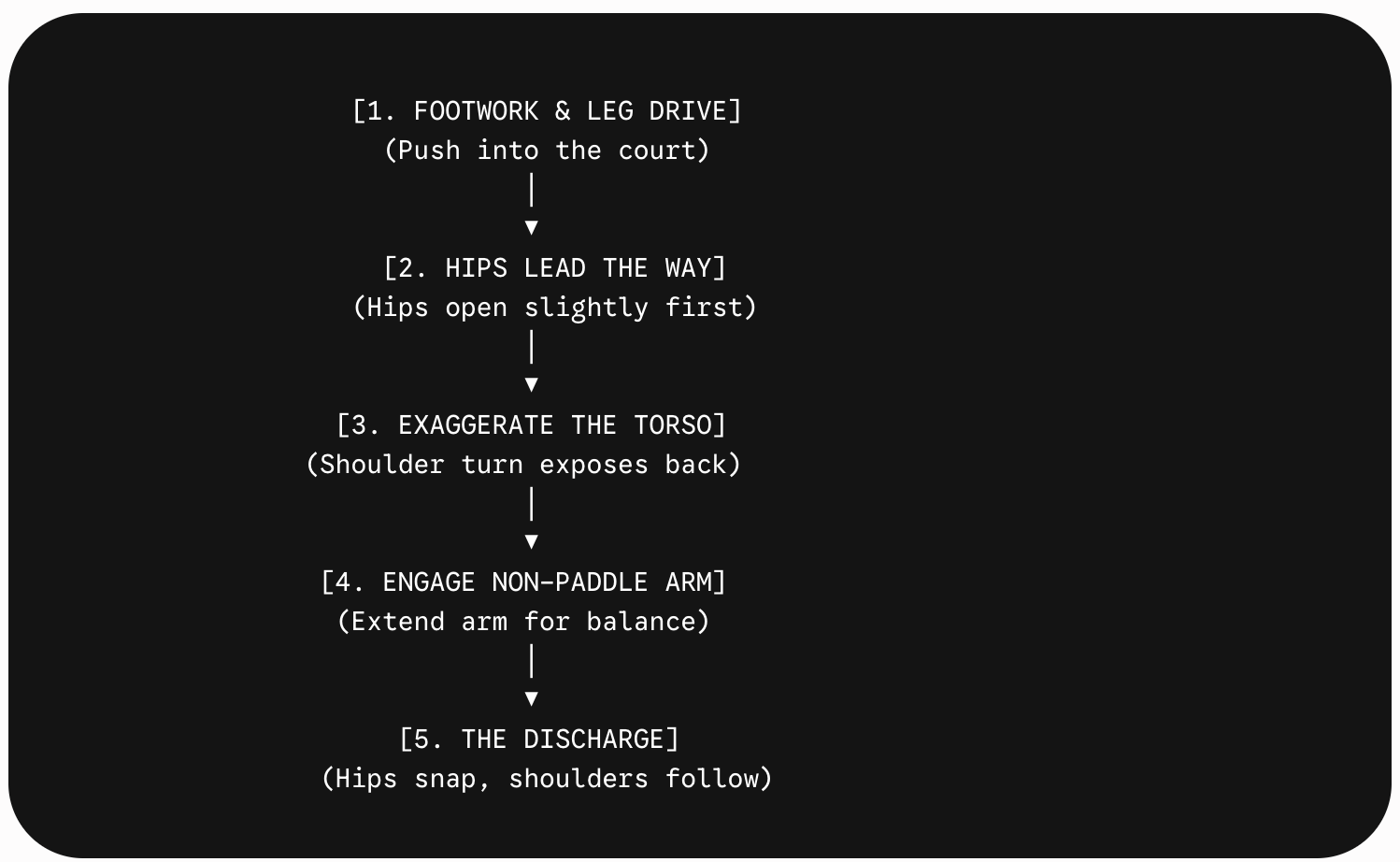
1. Establish Your Base (Footwork)
Before your upper body moves, you must establish an athletic stance. Push off your outside foot (your right foot for a right-handed forehand) to anchor your weight and initiate the rotational force.
2. Let the Hips Lead [Hips]
Allow your pelvic rotation to begin a fraction of a second before your shoulders turn. This sets up the correct kinetic sequencing.
3. Rotate Further Than Feels Natural [Shoulders]
Turn your paddle-side shoulder away from the ball. A universal coaching cue is to turn until your back is slightly visible to your opponent across the net. If your chest remains fully square to the net during your backswing, you are under-rotating.
4. Keep the Non-Paddle Arm Engaged [Non-Paddle Arm]
As you turn, extend your non-paddle arm across your body, pointing it generally toward the side line or incoming ball. This counterbalances your weight, prevents you from over-opening your chest too early, and acts as a physical gauge for your rotation.
5. Unwind in Sequence [Shoulders / Arm]
Fire your hips forward first. Let your shoulders trail behind naturally, snapping through the hitting zone only after the lower body has opened up.
Common Mistakes & The Cost
| Mistake | Penalty | Fix |
|---|---|---|
| Under-rotating the shoulders | Severe loss of depth, power, and shot consistency. | Exaggerate the coil in practice. Stand in front of a mirror or partner and turn until a sliver of your back is visible before swinging. |
| Isolating the upper body (No Hips) | Creates an arm-driven shot that stresses the rotator cuff and elbow. | Focus on your feet. Ensure your weight shifts to your back leg during the load phase to naturally force your hips to turn. |
| Simultaneous “Block” Rotation | Erases the X-Factor stretch; caps maximum paddle head speed. | Practice a “turn-pause-step-swing” rhythm during drill sessions. The intentional pause right before the step helps build muscle memory for separation. |
| Over-rotating at the Kitchen Line | Getting caught out of position during fast, modern hand battles. | Differentiate your shots. Use a full shoulder turn at the baseline, but switch to a compact shoulder turn for net play. |
Frequently Asked Questions
How do I know if I am turning my shoulders enough?
Ask a drilling partner to stand across the net and watch your stance. During a baseline drive or drop preparation, they should be able to see a portion of the back of your shirt. If they can only see your chest, your shoulder turn is shallow, and you are relying entirely on your arm.
Does the shoulder turn matter on soft shots like dinks?
Yes, but the scale is much smaller. On dinks and kitchen volleys, you want a highly compact shoulder turn. You still turn the shoulders to align your body with your target, but you minimize the backswing to prioritize touch, placement, and quick recovery over power.
What exactly is the X-Factor stretch?
The X-Factor stretch is the structural separation between your hip plane and your shoulder plane during a rotational swing. By starting your forward swing with your lower body while your upper body remains coiled, you stretch the core muscles, creating a rubber-band effect that snaps the paddle forward with significantly higher velocity.
Next Posts
Pickleball Positioning Relative to the Ball
Where your body should be relative to the ball for every pickleball shot type — and the specific 'banana peel' footwork mistake that causes late arrivals.
Pickleball Footwork Mastery
Learn the exact pickleball footwork patterns needed to master the baseline, transition zone, kitchen line, and wide-angle defense. Stop dropping points due to poor movement.
Pickleball Footwork at the Kitchen Line
Pickleball footwork at the kitchen line explained — why quiet, grounded feet paired with active hands beats either standing still or constant shuffling.
continue reading
Related Posts
Pickleball sliding practice explained — how a controlled slide spreads deceleration force over distance instead of one hard stop, and how to train it off-court.
Wide stance deceleration in pickleball explained — why sudden stops stress the knees and ankles, and how a wider base distributes that force safely.
Pickleball lob footwork explained step by step — the pivot, drop step, and shuffle or crossover run that replaces backpedaling for any lob.