
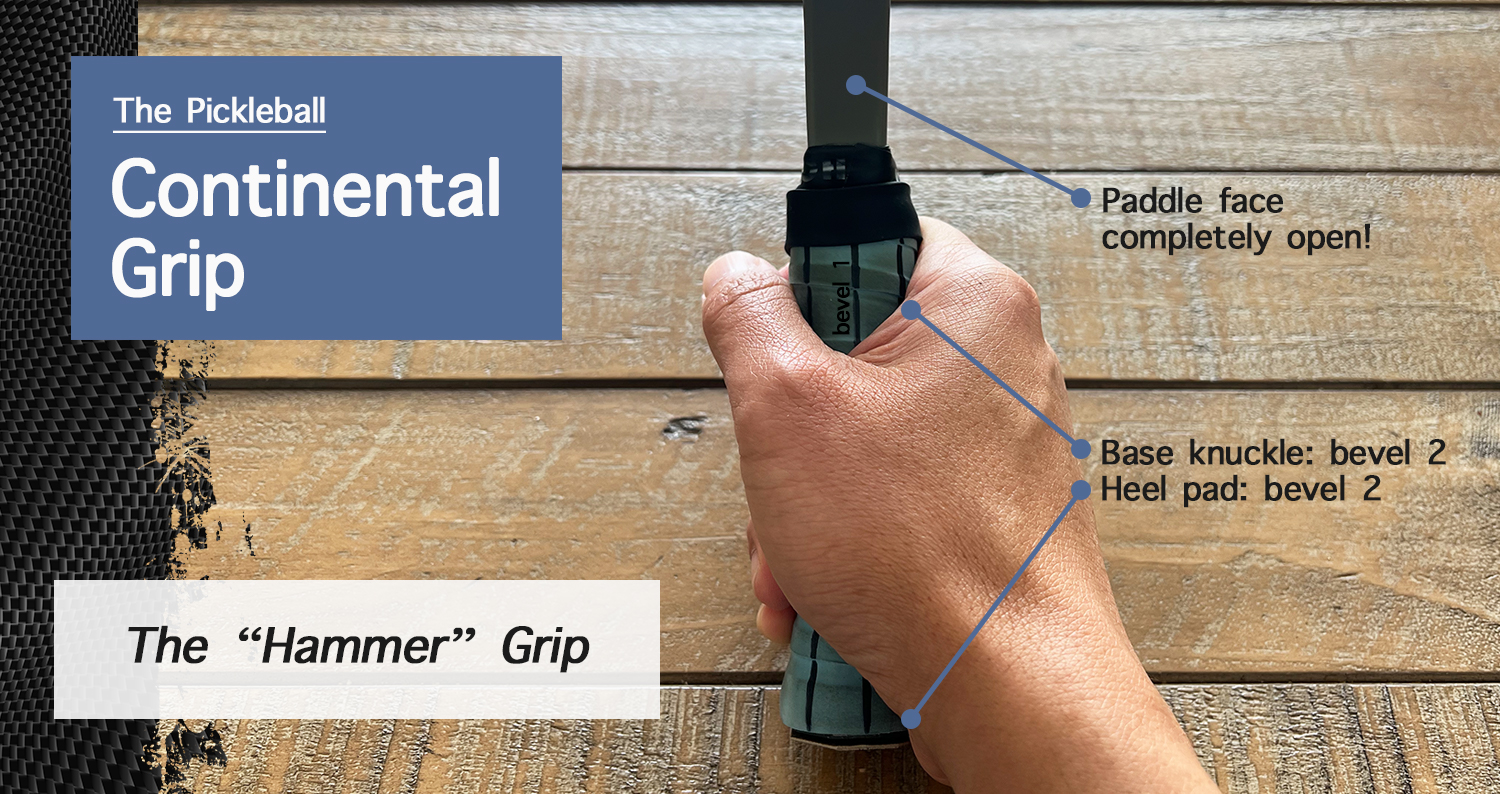
The Continental grip—frequently referred to as the “hammer grip”—places your hand on the paddle handle the exact way you would grasp a household hammer before driving a nail.
When applied to an octagonal pickleball handle, a right-handed player positions the base knuckle of the index finger and the heel pad of the palm flat against Bevel 2. For left-handed players, these landmarks rest on Bevel 8.
This positioning sets the paddle face into a perfectly neutral plane at rest—meaning the face is perpendicular to the ground, neither pre-opened toward the sky nor pre-closed toward the ground.
💡 The Crucial Concept
Because the Continental grip sits at a neutral midpoint, it requires zero grip adjustments when transitioning from a forehand volley to a backhand volley. This lack of friction is the primary reason why it serves as the absolute default stance at the non-volley zone (NVZ) line, where hyper-fast hand exchanges leave no physical time to shift your grip.
Quick Summary
-
Anatomical Alignment: Index base knuckle and palm heel pad rest cleanly on Bevel 2 (Righties) or Bevel 8 (Lefties). The “V” between the thumb and index finger points slightly left of center.
-
Best Used For: Dinks, punch volleys, drop shots, block volleys, overhead smashes, and resets at the kitchen line.
-
Weakest For: Generating heavy, baseline topspin drives (which naturally require a more closed face like the Eastern or Semi-Western grip).
-
Verdict: The gold standard, non-negotiable default starting grip for beginners and elite tournament players alike.
How to Find the Continental Grip: A Step-by-Step Guide
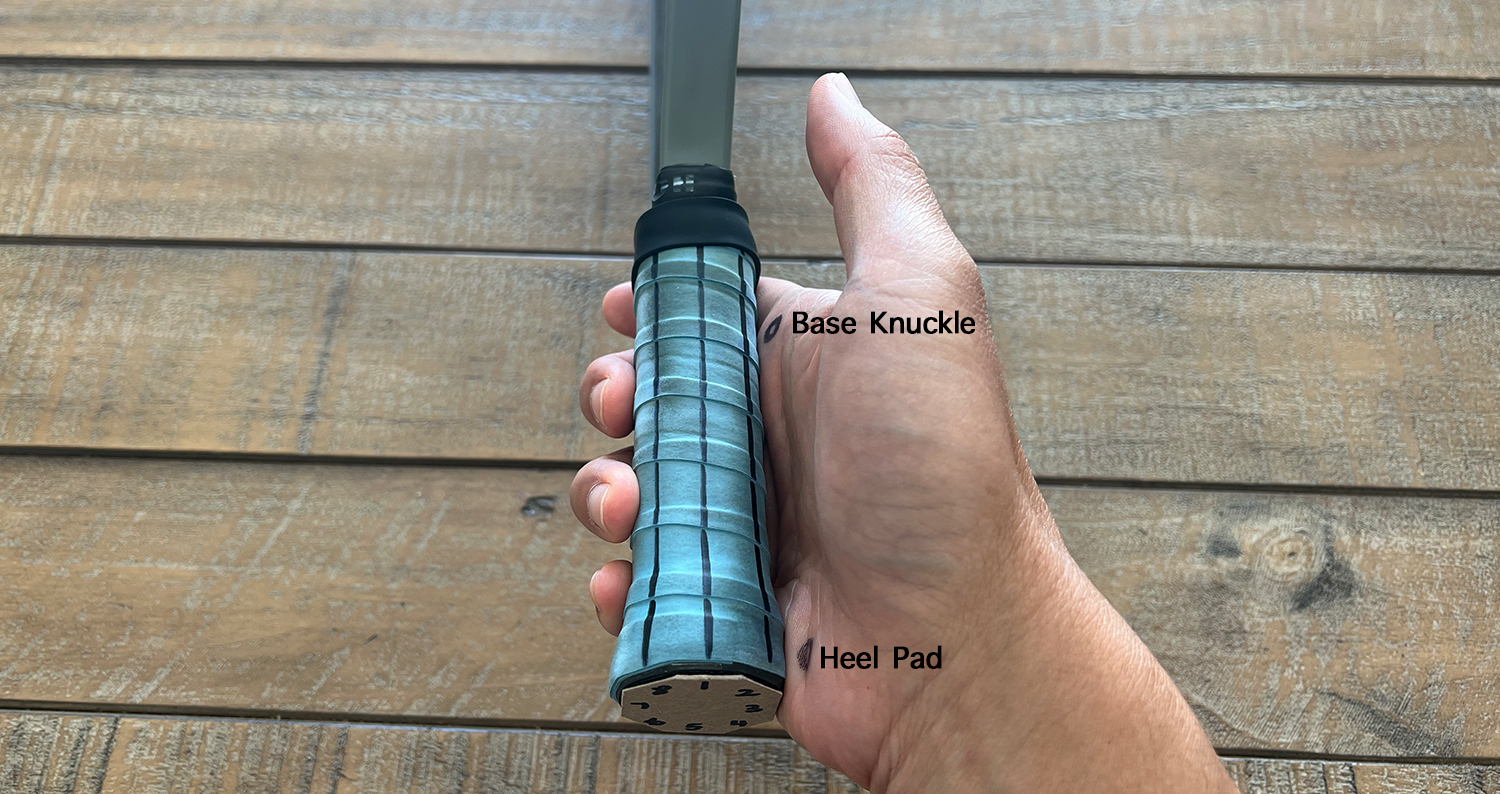
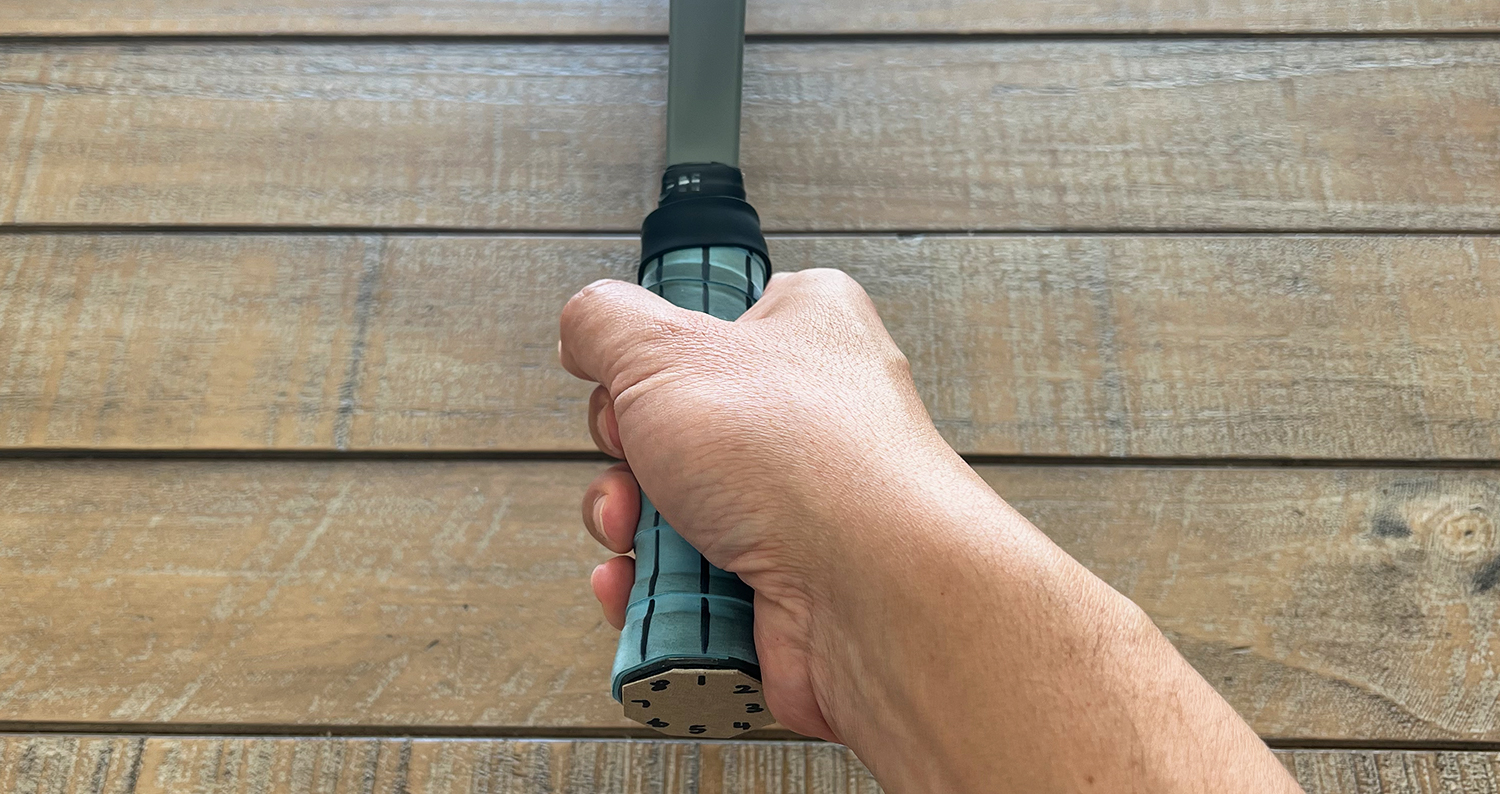
Follow this sequence to ensure your hand structure matches the exact geometry of the paddle handle:
1. Shake Hands with the Paddle
Hold the paddle completely on edge with your non-dominant hand. Extend your dominant hand and slip it down the handle as if you are giving it a firm handshake. This angle naturally guides your hand toward the correct bevel track.
2. Lock the Palm Heel Pad
Identify the fleshy, padded lower quadrant of your palm along the pinky side. For right-handers, settle this pad flush against Bevel 2 (the top-right diagonal bevel).
3. Stack the Index Base Knuckle
Locate the large base knuckle of your index finger. Place it directly onto that same Bevel 2 plane, perfectly aligning it vertically with your palm heel.
4. Check the “V” Alignment
Look down at the top of your hand. The “V-shape” crease formed between your thumb and index finger should sit directly over the top-left edge of the handle (pointing over Bevel 1 or slightly favoring the left side).
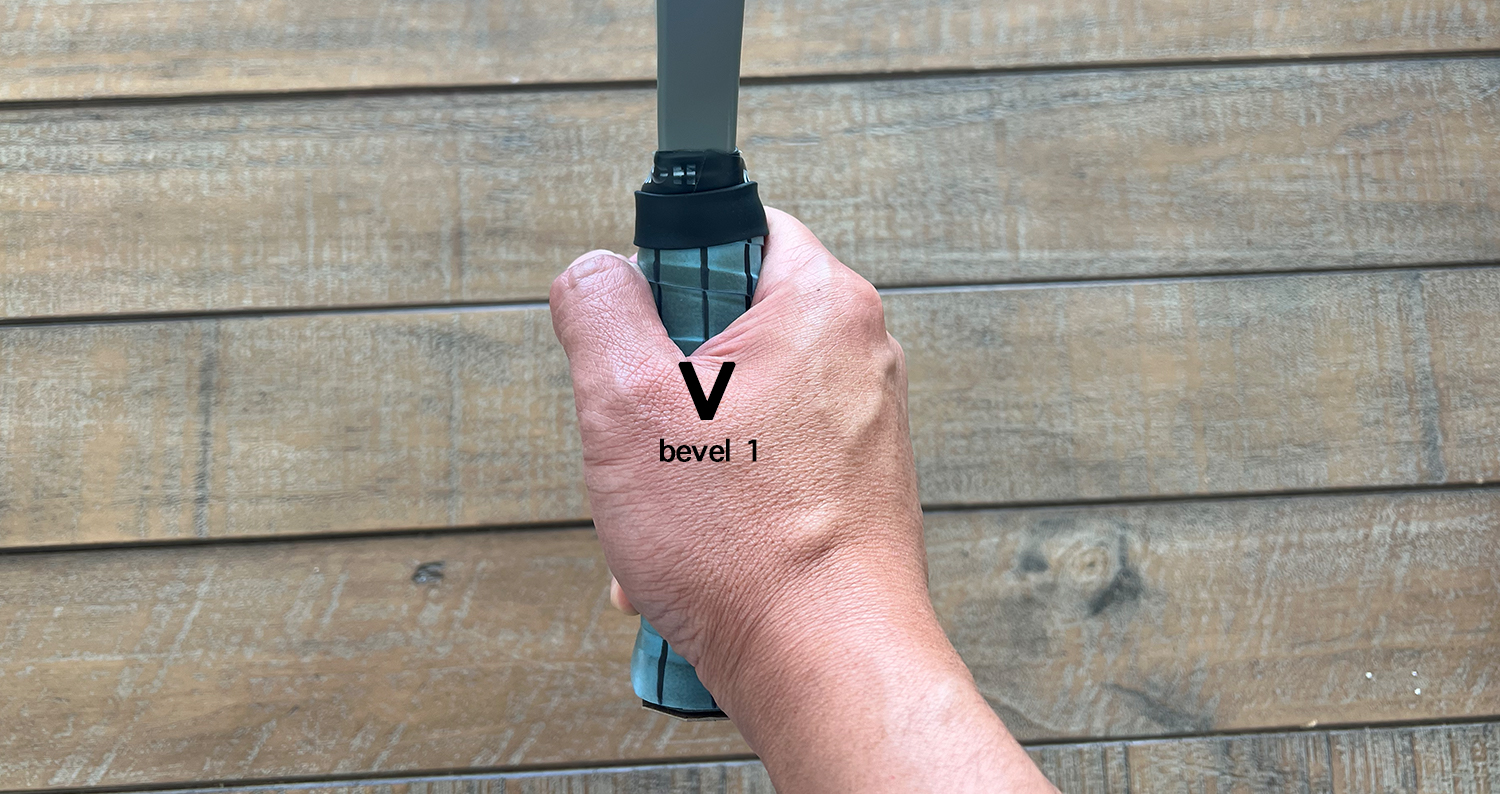
5. Support, Don’t Wrap the Thumb
Rest your thumb diagonally across the back surfaces of the handle for stabilization. Do not wrap your thumb forward flat against the face of the paddle, as this completely restricts fine-motor wrist adjustments.
6. Flaire and Loosen Your Fingers
Spread your fingers slightly across the grip rather than bundling them into a tightly clenched fist. Keep a slight, visible space between your middle fingers and your palm.
The Biomechanics: How This Grip Protects Your Wrist
At rest, the Continental grip places your wrist joint within its optimal anatomical range of motion—minimizing excessive flexion, extension, or radial/ulnar deviation.
Biomechanical research in racquet sports indicates that starting from a neutral wrist position distributes high-velocity contact loads far more evenly across the extensor and flexor tendon compartments than a pre-rotated or pre-flexed grip can.
-
On Drives: While the wrist naturally extends upon ball strike to stabilize the paddle head, starting from a Continental position means the wrist travels a significantly shorter extension path to achieve stability. This severely reduces the cumulative microtrauma that triggers lateral epicondylitis (commonly known as “pickleball elbow”).
-
On Backhand Reflex Volleys: The neutral face means you do not have to flip or over-rotate your wrist joint to present a flat blocking surface to a fast-moving ball. Instead, your elbow simply drives slightly outward, allowing the large musculature of the shoulder and arm to absorb the impact rather than forcing your delicate wrist tendons to take the brunt of the kinetic energy.
Body Positions by Importance
| Body Part | Why It Matters | What Happens If It’s Wrong |
|---|---|---|
| 1. Wrist | Functions as the primary shock absorber; sits near-neutral at rest to distribute load evenly across flexor and extensor complexes. | If forced out of neutral, the wrist must over-extend or over-flex at the moment of contact, leading to acute strain and tendonitis. |
| 2. Index Knuckle & Palm Heel | Serve as the dual anchor points on Bevel 2 to guarantee a highly repeatable, square paddle face. | If these landmarks are mismatched, the paddle will twist or slide in your hand during high-speed impact, destroying tracking consistency. |
| 3. Thumb | Acts as a diagonal stabilizer providing structural support without overriding joint mobility. | Wrapping the thumb flat onto the paddle face completely locks up the wrist, making micro-adjustments for dinks and resets mechanically impossible. |
| 4. Elbow | Dictates the tracking path; drives outward during backhand volleys to open up the paddle face naturally. | A locked or passive elbow forces the player to flip their wrist to create target angles, spiking raw joint strain. |
Common Mistakes & The Cost
The Mistake: Palm Heel Drifts to Bevel 1
-
The Penalty: Over the course of a long, sweaty match, your hand slowly rotates clockwise. This shifts your paddle into an accidental backhand-favoring grip, causing your forehands to sail high and deep out of bounds.
-
The Fix: Implement a “Mid-Point Check.” Glance down at your hand layout between every single point. Explicitly realign your index knuckle and palm heel to Bevel 2 before getting back into your ready stance.
The Mistake: The “Frying Pan” Thumb Wrap
-
The Penalty: Pressing the thumb pad flat against the paddle face to try and force stability entirely immobilizes the joint, preventing you from executing soft, feather-touch dinks and dropping pace on resets.
-
The Fix: Perform a set of shadow swings before your session. Intentionally focus on relaxing the thumb, feeling it drape diagonally across the handle until the placement is locked into your muscle memory.
The Mistake: Death-Gripping the Handle
-
The Penalty: Squeezing the handle with maximum force collapses the natural “V” space of your hand. This results in severe forearm pump, rapid fatigue, and a complete loss of touch at the net.
-
The Fix: Apply the 3-to-7 Pressure Rule. On a scale of 1 to 10 (where 1 is dropping the paddle and 10 is white-knuckled), maintain a loose 3 while waiting in your ready position or dinking. Only ramp up to a firm 7 at the fractional split-second of ball contact, instantly relaxing back to a 3 afterward.
Frequently Asked Questions
Should beginners start with a Continental or Eastern grip?
Continental is universally recommended as the foundational baseline grip. It teaches clean footwork and proper body alignment because it allows you to hit every fundamental shot without needing to adjust your hand on the handle. Once a player masters net play and wants to add heavy baseline drive power, they can then layer in the Eastern grip as an secondary tool.
Why are my topspin drives so weak with a Continental grip?
The neutral face of the Continental grip does not pre-close the paddle head. Because the paddle face points directly at the net rather than slightly downward, creating topspin requires a highly exaggerated low-to-high swing path and a crisp wrist snap. It is a built-in mechanical limitation of the grip, not a flaw in your athleticism.
Is the Continental grip effective for body-tracking defense?
Yes, it is the absolute best defense grip available. When an opponent speeds up the ball directly at your chest or dominant shoulder, a Continental grip allows you to instantly raise your paddle into a backhand reflex block. Because the human anatomy can cross the body much faster using a backhand motion than a forehand motion, keeping your paddle in a neutral Continental grip acts as your shield against body shots.
Next Posts
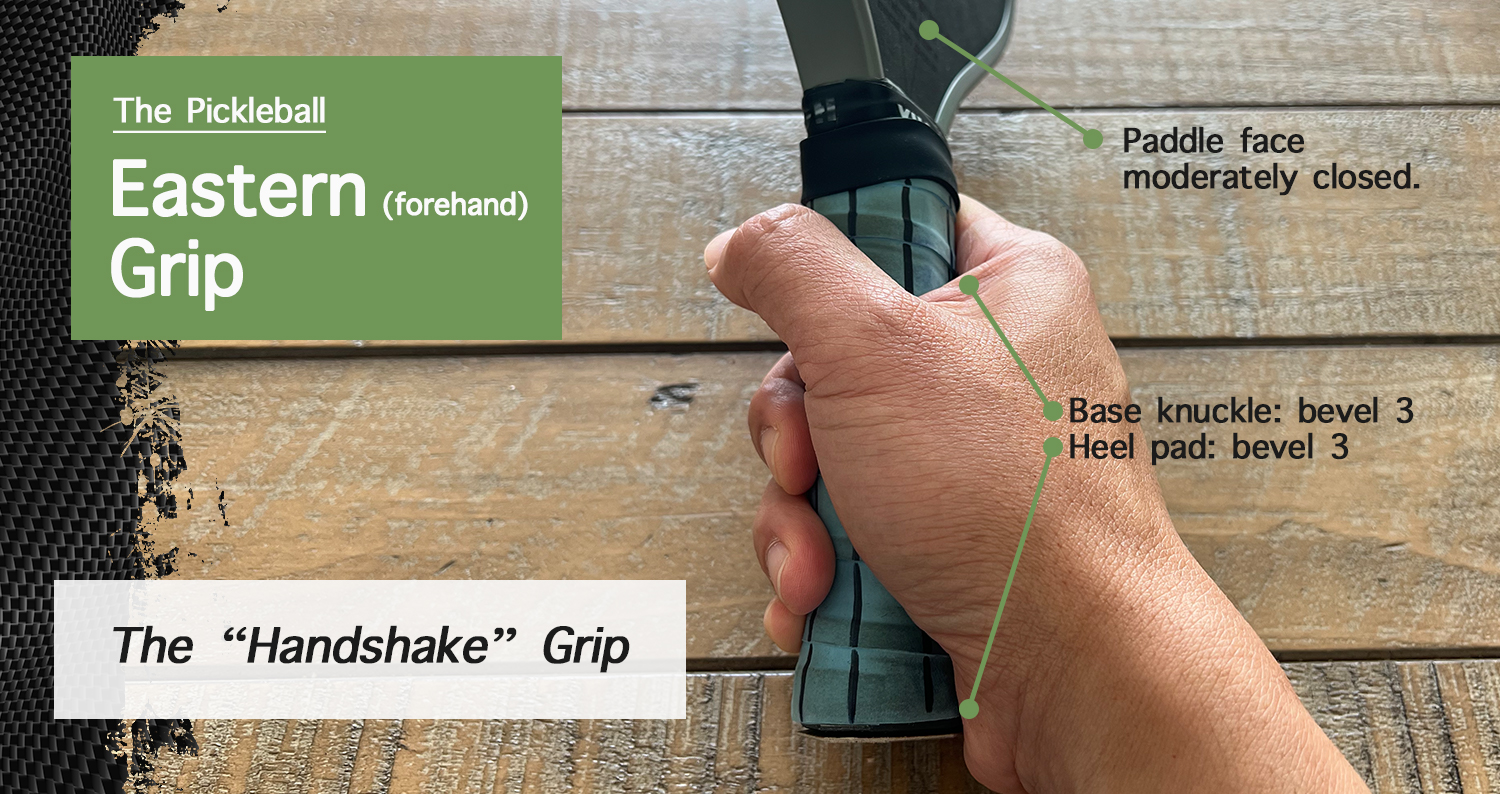
Eastern Grip in Pickleball
The Eastern grip in pickleball explained with exact hand placement, what it does to your wrist at contact, and where it outperforms Continental.
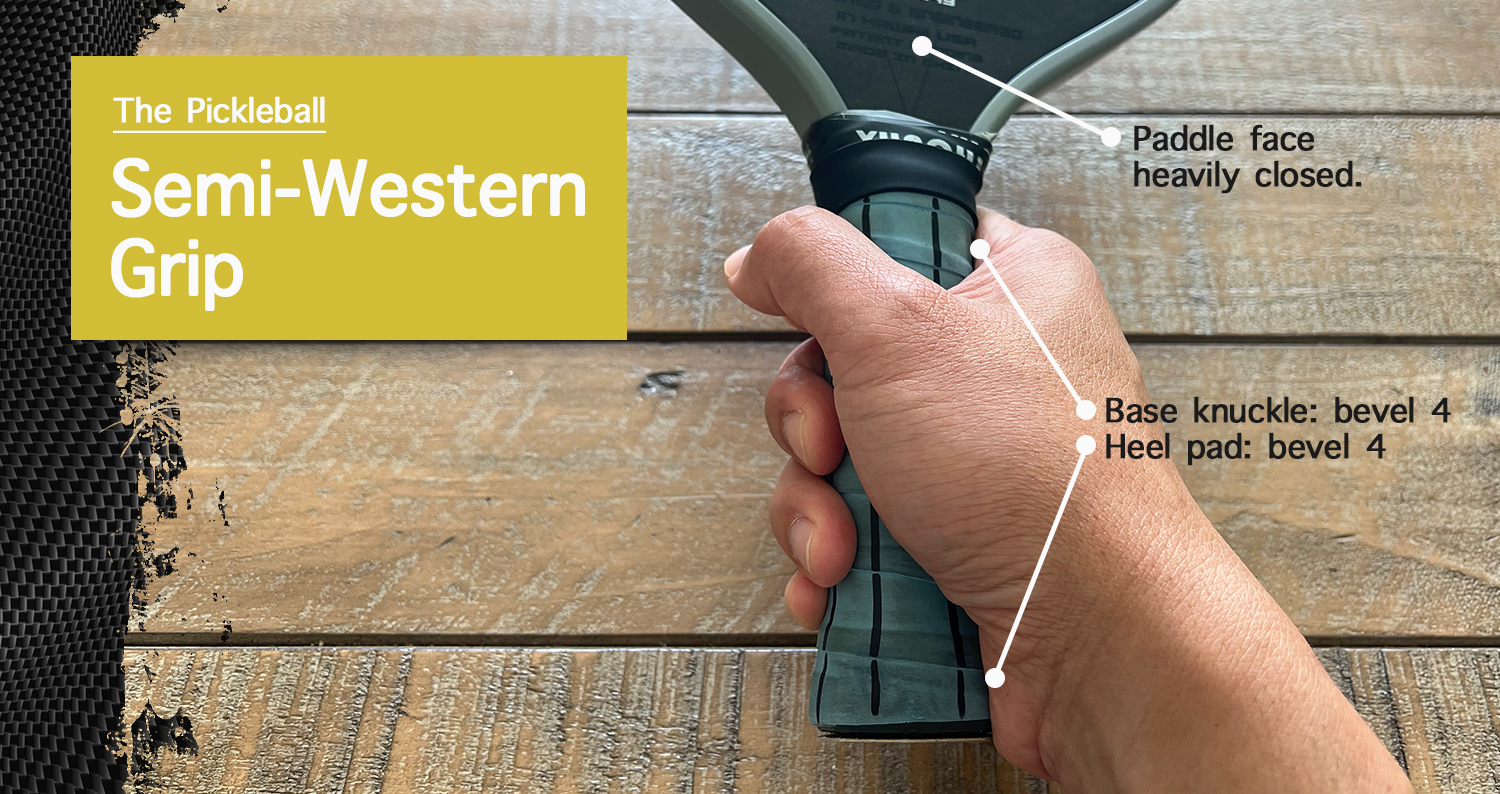
Semi-Western Grip in Pickleball
The Semi-Western grip explained — exact bevel placement between Eastern and Western, the topspin it unlocks, and the backhand cost.
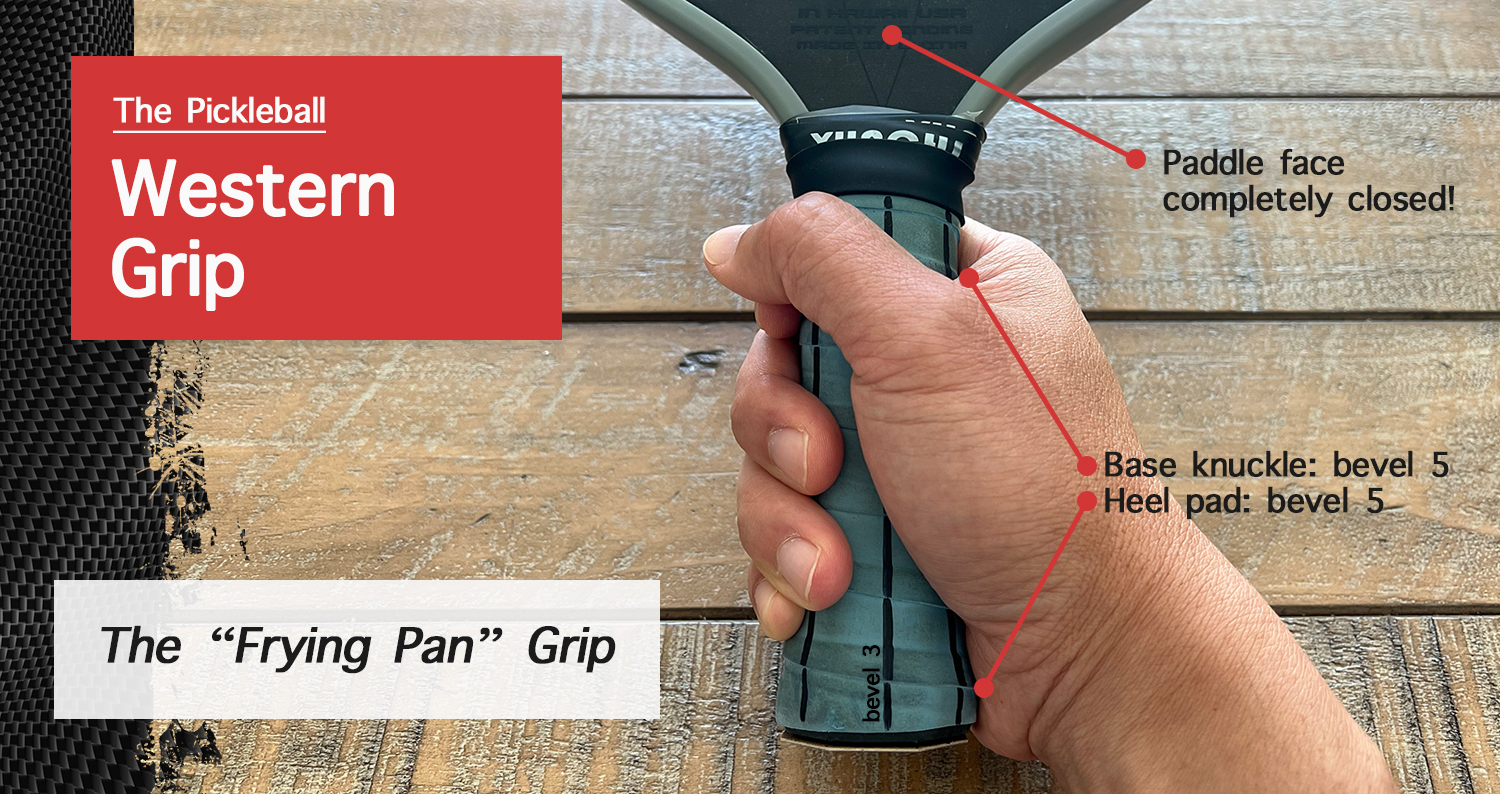
Western Grip in Pickleball
The Western grip explained in full — exact hand position, why it maximizes forehand topspin, and why it's the rarest grip at the pro level.
continue reading
Related Posts
Pickleball sliding practice explained — how a controlled slide spreads deceleration force over distance instead of one hard stop, and how to train it off-court.
Wide stance deceleration in pickleball explained — why sudden stops stress the knees and ankles, and how a wider base distributes that force safely.
Pickleball lob footwork explained step by step — the pivot, drop step, and shuffle or crossover run that replaces backpedaling for any lob.