
An open stance positions your feet and hips parallel to the net, with your chest and shoulders facing directly forward toward your opponent. In this stance, there is no forward step and minimal rotational coil. Any power or control generated comes almost entirely from hip rotation in place rather than linear weight transfer.
This is the foundational, default stance you will spend the most time in at the kitchen line (Non-Volley Zone). The quiet-but-active feet required for an elite ready position operate directly from this open base.
CRUCIAL CONCEPT
The open stance isn’t just a defensive fallback. At the kitchen line, it is the structural requirement that lets you slide to a backhand or step into a forehand without crossing your legs—which is exactly what fast-hands exchanges demand.
Quick Summary
-
The Position: Feet and hips parallel to the net, chest facing forward—no forward step.
-
Best For: Dinks, volleys, fast kitchen-line hands battles, defensive resets, and handling wide pulls.
-
The Advantage: Fastest recovery of the three stances because your body is already facing the direction you need to react.
-
The Trade-off: Trades maximum rotational power for instant recovery and court coverage.
How to Set It Up
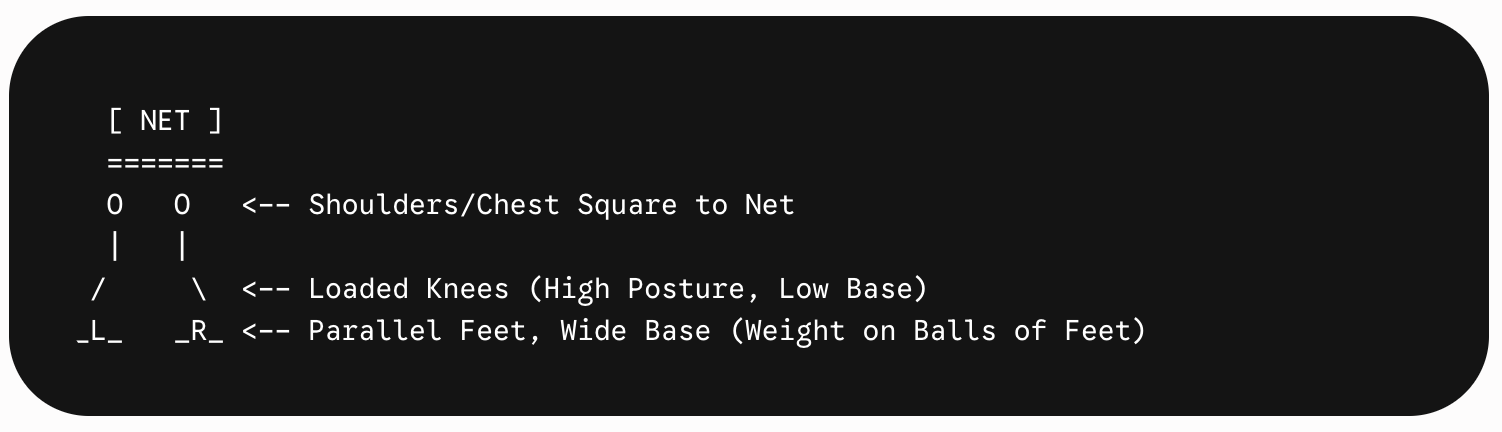
-
Square Your Chest
[Chest / Shoulders]Face your chest and shoulders directly toward the net rather than turning sideways.
-
Keep Feet Parallel & Wide
[Feet]Position both feet parallel to the net, wider than shoulder-width apart for ultimate lateral stability.
-
Stay Loaded on Your Toes
[Weight Distribution]Do not sit back on your heels or drop into a deep, immobile squat. Keep your weight distributed 60/40 on the balls of your feet. This keeps your posture high and your feet light.
-
Let the Hips Do the Work
[Hips]When a shot requires pace, generate force through hip rotation in place rather than lunging or reaching.
The Biomechanics: Instant Readiness vs. Limited Torque
Because there is no forward step, an open stance cannot access the linear weight transfer that powers a closed-stance drive. Instead:
-
Available power comes entirely from hip rotation in place, which produces less torque than a full kinetic chain transfer.
-
The primary benefit is recovery speed. Your chest is already facing the court, meaning zero “un-rotation” time is required before your next move.
-
The “Zero Forward” Paddle Principle: To make this stance work, your paddle must stay in front of your body in “positive space.” Pulling your paddle back into “negative space” creates an excessive backswing, which destroys the instant-readiness advantage of the stance.
The Moving Wall
When you stand at the kitchen line, you and your partner form a defensive wall. Utilizing an open stance allows you to execute the “zipper effect”—sliding laterally in perfect unison to close down court angles.
The Exception: A Ball Driven Directly at Your Body
While the open stance is the correct default at the kitchen line, it has one genuine exception: the body shot (Chicken Wing).
When an opponent speeds a ball directly at your dominant shoulder or hip, a fully open stance leaves your paddle with nowhere to go because the ball is entering the exact space your body occupies.
In this specific situation, you must execute a quick, partial close—turning your shoulders slightly sideways to create physical space between your torso and the incoming ball. This allows your paddle to find a clean contact point. The moment the ball is cleared, you must instantly snap back to a square open stance.
Body Positions by Importance
| Body Part | Why It Matters | What Happens If It’s Wrong |
|---|---|---|
| 1. Chest / Shoulders | Facing the net is the defining feature, eliminating un-rotation time before your next move. | Turning sideways reintroduces a recovery step, leaving you vulnerable to fast counters. |
| 2. Paddle Position | Must stay out in front (“Zero Forward”). | Excessive backswings cause late contact and pop-ups. |
| 3. Hips | The sole power source available, generated through rotation in place. | Expecting drive-level power leads to arm-strain compensation rather than real pace. |
| 4. Feet & Weight | Parallel, wide positioning with weight 60/40 forward supports fast lateral sliding. | Sinking onto your heels or crossing your feet causes a total loss of balance. |
Common Mistakes & The Cost
1. Trying to generate drive-level power from an open stance
-
Penalty: The stance isn’t built for it, resulting in arm-strain compensation, wrist instability, and poor accuracy.
-
Fix: Accept reduced power on open-stance shots. Prioritize placement, depth, and consistency instead.
2. Closing the stance reflexively at the kitchen line under pressure
-
Penalty: Costs you your instant-recovery advantage exactly when reaction time matters most.
-
Fix: Consciously hold your open stance through quick kitchen exchanges, even when rushed.
3. Crossing the body to reach a wide ball instead of sliding
-
Penalty: Slower, less balanced, and leaves massive gaps open for your opponents.
-
Fix: Practice lateral slides and small drag steps specifically from an open base during kitchen drills.
Frequently Asked Questions
Is open stance only for defense?
No. At the kitchen line, it is frequently used offensively for dinks, volleys, and put-away shots because it keeps you physically closest to the net without committing to a step-in.
Can I hit a put-away smash from an open stance?
Yes. Put-aways near the kitchen line typically utilize an open stance. Keeping your position tight to the net and maintaining a fast recovery position matters more in that zone than the extra power a step-in would add.
Why does open stance feel less powerful than closed stance?
It feels less powerful because it is less powerful for pure drives. Open stance purposefully trades the linear weight transfer of a closed stance for instant recovery, which is the mathematically superior trade-off at the kitchen line.
Is open stance used anywhere else on the court?
Yes. An increasing number of advanced players and touring pros are adopting an open stance serve. Because modern rules restrict service releases to hip height, an open stance allows players to pre-load their hip rotation and strike the ball quickly without the need for a timed forward step.
Next Posts
Pickleball Kinetic Chain
The pickleball kinetic chain explained — the legs-to-paddle power sequence that separates effortless drives from arm-only swinging.
Pickleball Hip Rotation
Pickleball hip rotation timing explained — why hips fire before the torso, shoulder, and arm, and what happens when the sequence gets reversed.
Pickleball Shoulder Turn
Pickleball shoulder turn explained — how far to rotate, why it follows the hips rather than leading them, and the separation that creates real power.
continue reading
Related Posts
Pickleball sliding practice explained — how a controlled slide spreads deceleration force over distance instead of one hard stop, and how to train it off-court.
Wide stance deceleration in pickleball explained — why sudden stops stress the knees and ankles, and how a wider base distributes that force safely.
Pickleball lob footwork explained step by step — the pivot, drop step, and shuffle or crossover run that replaces backpedaling for any lob.