
Mastering your footing in pickleball isn’t about memorizing rigid formulas; it is about understanding how your base dictates your power, shot control, and recovery speed. Your stance forms the literal foundation of your shot, influencing your strike long before the paddle touches the ball.
What Exactly Is a Pickleball Stance?
Your stance is the angle of your feet and hips relative to the net at the exact millisecond you make contact with the ball.
Rather than three rigid, isolated boxes, stance exists on a fluid, live-play spectrum. The best players move fluidly between positions rather than picking one and staying there for the whole point.
💡 The Core Trade-Off
A closed stance generates the most torque but costs you a recovery step. An open stance recovers instantly but caps how much rotational power you can generate. Every stance choice is a direct trade-off between power and recovery speed, made shot by shot.
The Three Stances Breakdown
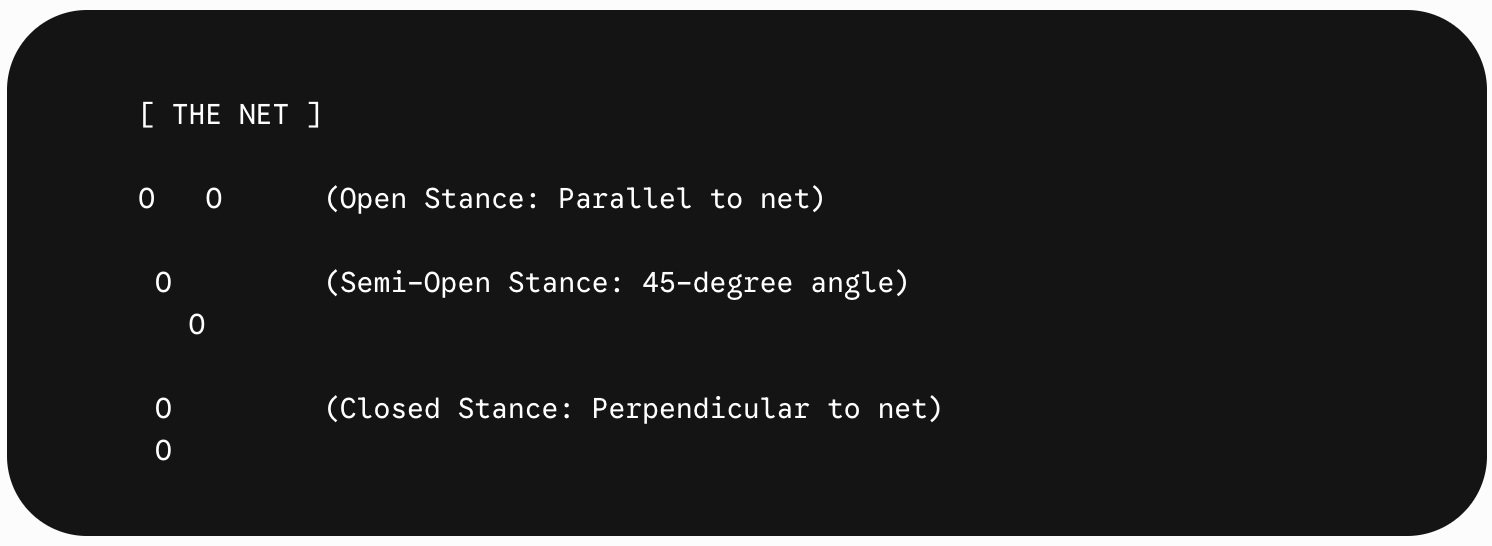
1. Closed Stance
-
Body Alignment: Feet and hips are perpendicular to the net, with your non-paddle shoulder pointing directly at your target.
-
Pros: Unlocks maximum torque and linear power transfer.
-
Cons: The slowest of the three stances to recover from, costing you a vital recovery step.
-
Best Used For: Baseline drives with real, ample setup time.
2. Semi-Open Stance
-
Body Alignment: The front foot rests at roughly a $45^\circ$ angle relative to the net, with the back foot planted wider.
-
Pros: The perfect hybrid. It remains coiled enough for real power while keeping the hips open enough to recover quickly and disguise your shot direction.
-
Cons: Requires active footwork discipline to find consistently.
-
Best Used For: The universal “live play” default for the majority of mid-court shots.
3. Open Stance
-
Body Alignment: Feet and hips are parallel to the net, leaving your chest completely forward and square to the court.
-
Pros: Delivers the fastest possible recovery speed and lateral reset.
-
Cons: Caps how much rotational power you can generate because there is no forward step; it relies on hip rotation alone for pace.
-
Best Used For: Dinks, volleys, and anything at the kitchen line.
The Precise Order: Split Step, Load, and Stance
Your stance doesn’t happen in a vacuum, and it doesn’t just happen on its own. To find the correct footing, your body must execute a quick, three-part sequence right as the ball arrives:
-
The Split Step: This is the small, balanced, two-foot hop timed to your opponent’s contact. It loads both legs and lets you read the ball’s depth and speed from a completely neutral athletic platform.
-
The Load Step: Once you are at the ball, you actively transfer and stack your body weight onto your hitting-side foot (e.g., your right foot for a right-handed forehand). This coils your hips and acts like winding up a heavy rubber band.
-
Establish Stance: From that loaded foot, you plant your remaining foot to form your final footprint at the microsecond of impact—settling into an open, semi-open, or closed position depending on how much setup time you have. Trying to force a stance without that preceding split step and load usually means arriving late and hitting off-balance.
Which Stance Is Best Suited for Beginners?
1. Semi-Open (The Default Base)
The semi-open stance is the most useful position to build your fundamentals around. Most coaches describe it as the default for the majority of live-play shots. It is coiled enough to teach beginners real rotational power, while still being forgiving enough to recover from if a player’s timing is occasionally early or late.
2. Open Stance (The Kitchen Standard)
An open stance is worth learning early specifically for kitchen-line play. Because dinks and volleys make up such a massive share of recreational rallies, keeping your chest open to the net maximizes your reaction speed and defensive stability.
3. Closed Stance (The Advanced Add-On)
The closed stance should be introduced more deliberately and later on. While it is highly valuable as a tool for reinforcing a proper unit turn once a player has time to set up, it is also the easiest of the three to misuse in fast exchanges where it simply doesn’t belong.
Why This Matters for Your Game
Your stance determines two things on every single shot: how much power is available to you, and how quickly you can reset for whatever comes next.
Players who use one single stance regardless of the situation are always unconsciously accepting one half of that trade-off without realizing they have a choice—either leaving clean power on the table from an open stance when they had plenty of time to close, or getting caught flat in a closed stance during a fast exchange that required a semi-open or open reset instead.
The X-Factor Stretch
This connects directly to a deeper principle in sports biomechanics: the separation between hip rotation and shoulder rotation—sometimes called the X-factor stretch—is a documented predictor of swing velocity. Your stance is the structural valve that makes that physical separation possible or completely unavailable on a given shot, which is why your footing is worth treating as a deliberate decision rather than a random habit.
Contact Point Shifts With Stance
Each stance fundamentally changes where contact needs to happen relative to your body:
-
In a Closed Stance: Contact must happen further forward, in front of the lead hip. Because your torso is turned sideways, the paddle has to square up across your body to reach the ball at all. Hitting late in a closed stance is exactly why shots net or shank off the frame—there isn’t enough forward distance left for the paddle face to square up properly.
-
In an Open Stance: Contact can happen slightly later and closer to the body. Because your chest is already facing the court, the paddle doesn’t have as far to travel to get square to your target.
Frequently Asked Questions
Do I need to memorize exact foot angles for each stance?
No. Angles like 45 degrees are useful reference points, not rules to consciously calculate mid-point. Most advanced players describe flowing between stances organically based on available time and ball depth rather than measuring foot placement.
Is one stance just better than the others overall?
No. Each is a deliberate trade-off between rotational power and recovery speed. Semi-open is the most commonly cited default because it balances both elements reasonably well, not because it is universally correct.
Why do pros seem to use the semi-open stance so often?
Multiple coaching sources describe the semi-open stance as the player’s “comfort zone.” It stays coiled enough to execute a heavy, powerful drive while keeping the hips free to adjust direction late, which allows players to easily disguise their shot direction from opponents.
Do I need a different stance for my forehand versus my backhand?
The same three stances apply to both sides of your body. While the leading foot and the direction of your hip rotation will flip, the underlying trade-offs between power, torque, and recovery speed remain completely identical regardless of which side you are hitting.
Next Posts
Open Stance in Pickleball
Open stance in pickleball explained — chest facing the net, instant recovery, and why it's the default for dinks, volleys, and defensive resets.
How to Choose Your Pickleball Stance in Real Time
How to choose your pickleball stance mid-point — using ball depth, available time, and your next move to pick closed, semi-open, or open instantly.
The Unit Turn in Pickleball
The pickleball unit turn explained — rotating hips, shoulders, and non-paddle arm together as one unit, with the exact turn-pause-step-swing sequence.
continue reading
Related Posts
Pickleball sliding practice explained — how a controlled slide spreads deceleration force over distance instead of one hard stop, and how to train it off-court.
Wide stance deceleration in pickleball explained — why sudden stops stress the knees and ankles, and how a wider base distributes that force safely.
Pickleball lob footwork explained step by step — the pivot, drop step, and shuffle or crossover run that replaces backpedaling for any lob.