
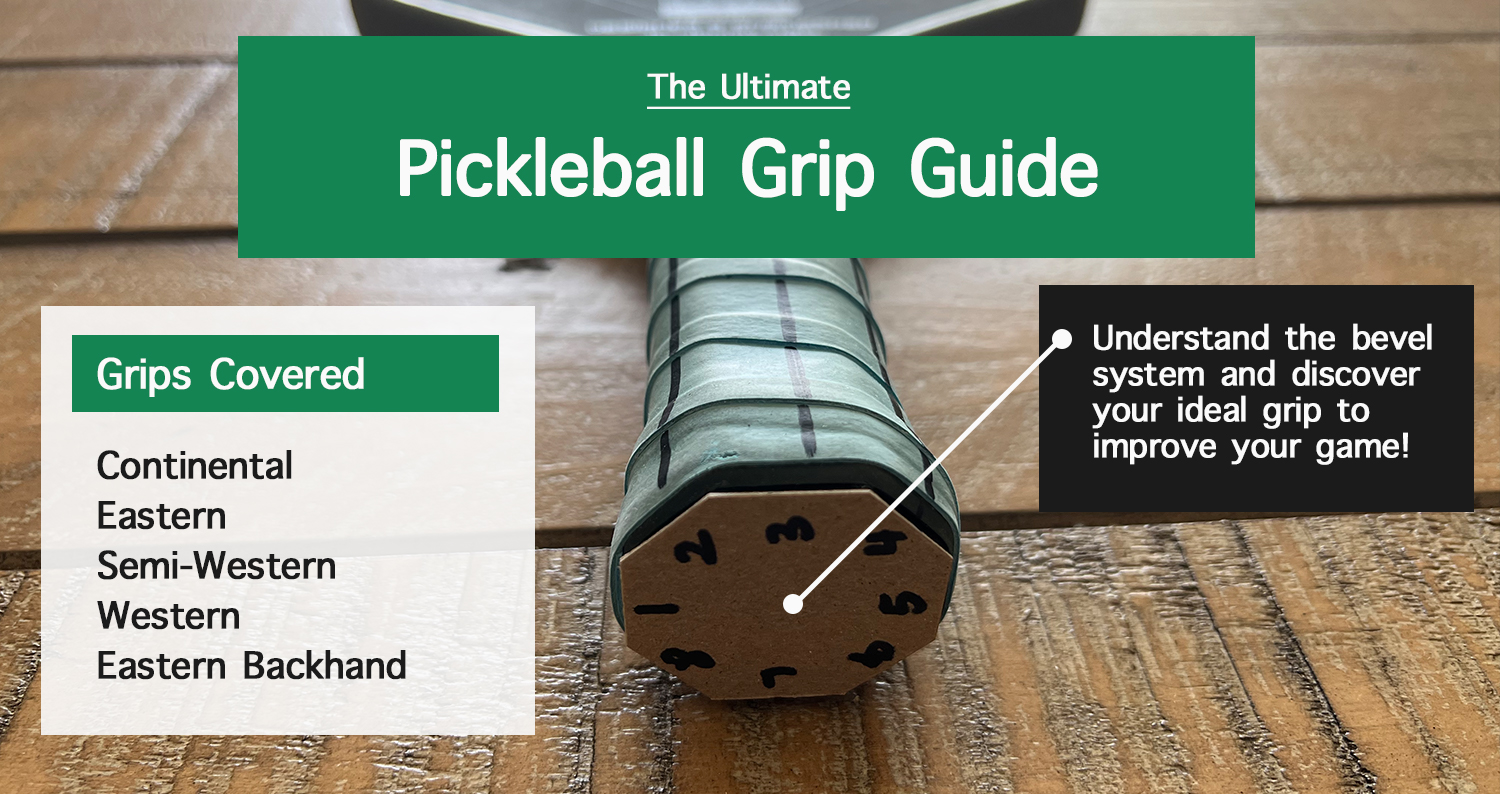
How you hold your pickleball paddle dictates every single shot you hit. Your grip sits at the absolute foundation of your kinetic chain. Unlike dynamic movements like footwork or hip rotation, your grip is a static variable—set before the ball is in motion and held throughout the swing.
Because it determines the natural resting angle of your paddle face, a mismatched grip cannot be rescued by great footwork downstream. If the paddle face starts in the wrong position, your wrist, forearm, and elbow must overcompensate to square it at contact.
Getting your hand position right is the single highest-leverage adjustment you can make to your game. This guide covers everything you need to know about the paddle bevel system, the five primary grip types, and how to find the perfect hold for your playstyle.
The Handle Anatomy: Bevel Numbering and Hand Landmarks
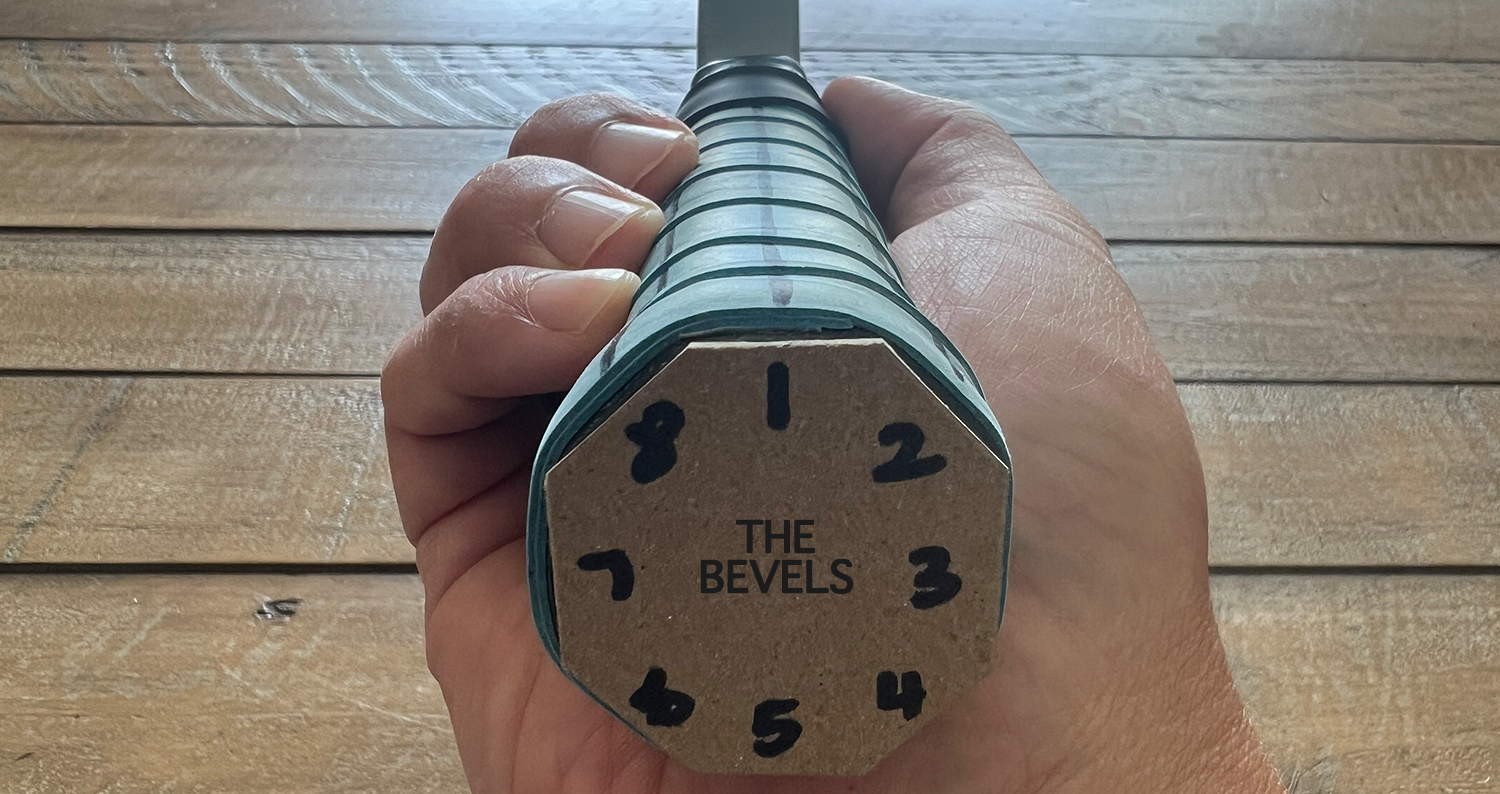
To understand pickleball grips, you must first understand the shape of the handle. Nearly all pickleball paddle handles are octagonal, featuring eight flat sides called bevels running down their length.
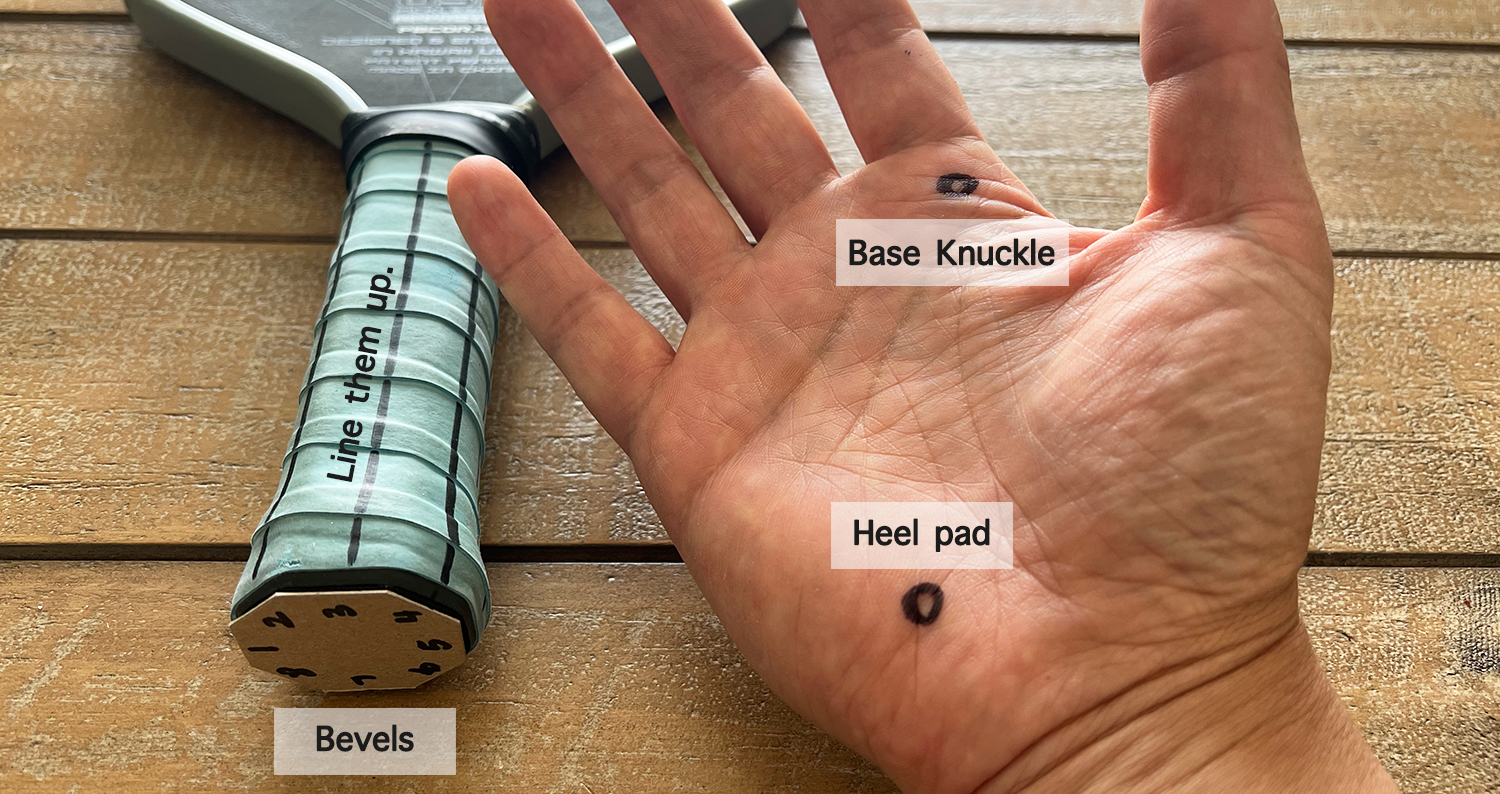
To find your grip type, you look at where two primary landmarks on your dominant hand rest on these bevels:
-
The base knuckle of your index finger.
-
The heel pad of your palm.
The Standard Bevel System
For a right-handed player looking down at the butt cap of the paddle with the paddle head held vertically (edge guard facing the sky):
-
Bevel 1: The flat top surface.
-
Bevel 2: The diagonal slant to the right.
-
Bevel 3: The flat right vertical side.
-
Bevel 4: The diagonal slant on the bottom-right.
-
Bevel 5: The flat bottom surface.
-
Bevels 6, 7, and 8 continue up the left side.
Left-Handed Players: All of the rotations described reverse direction. While a right-hander rotates clockwise to move from Continental toward Eastern, a left-hander rotates counter-clockwise. The bevel numbers stay identical; only the direction of travel around the handle flips.
The “V” Landmark Alternative
Many pickleball paddles feature more rounded, condensed handles than tennis racquets, making it difficult to feel the exact edges of all eight bevels. If you cannot easily count the bevels by feel, track the “V” shape formed between your thumb and index finger. Where that “V” rests relative to the top of the handle provides an immediate, reliable guide.
Handle Size vs. Grip Type: A Critical Calibration
Grip type (how far your hand rotates) is a completely separate variable from handle circumference (the actual thickness of the handle). If your handle size is incorrect, your grip will never feel fully settled:
-
Handle Too Small: Your fingers wrap too far around, naturally forcing your hand into an accidental, overly closed grip without your realization.
-
Handle Too Large: It limits your wrist snap, prevents a relaxed hold, and makes switching grips mid-rally sluggish and clumsy.
Tip: If you fall between sizes, opt for the smaller handle. You can easily build up a thin handle with an overgrip, but you cannot shrink a core that is too thick.
The 5 Core Pickleball Grips Explained
Every grip represents a mechanical trade-off between forehand topspin potential and backhand utility.
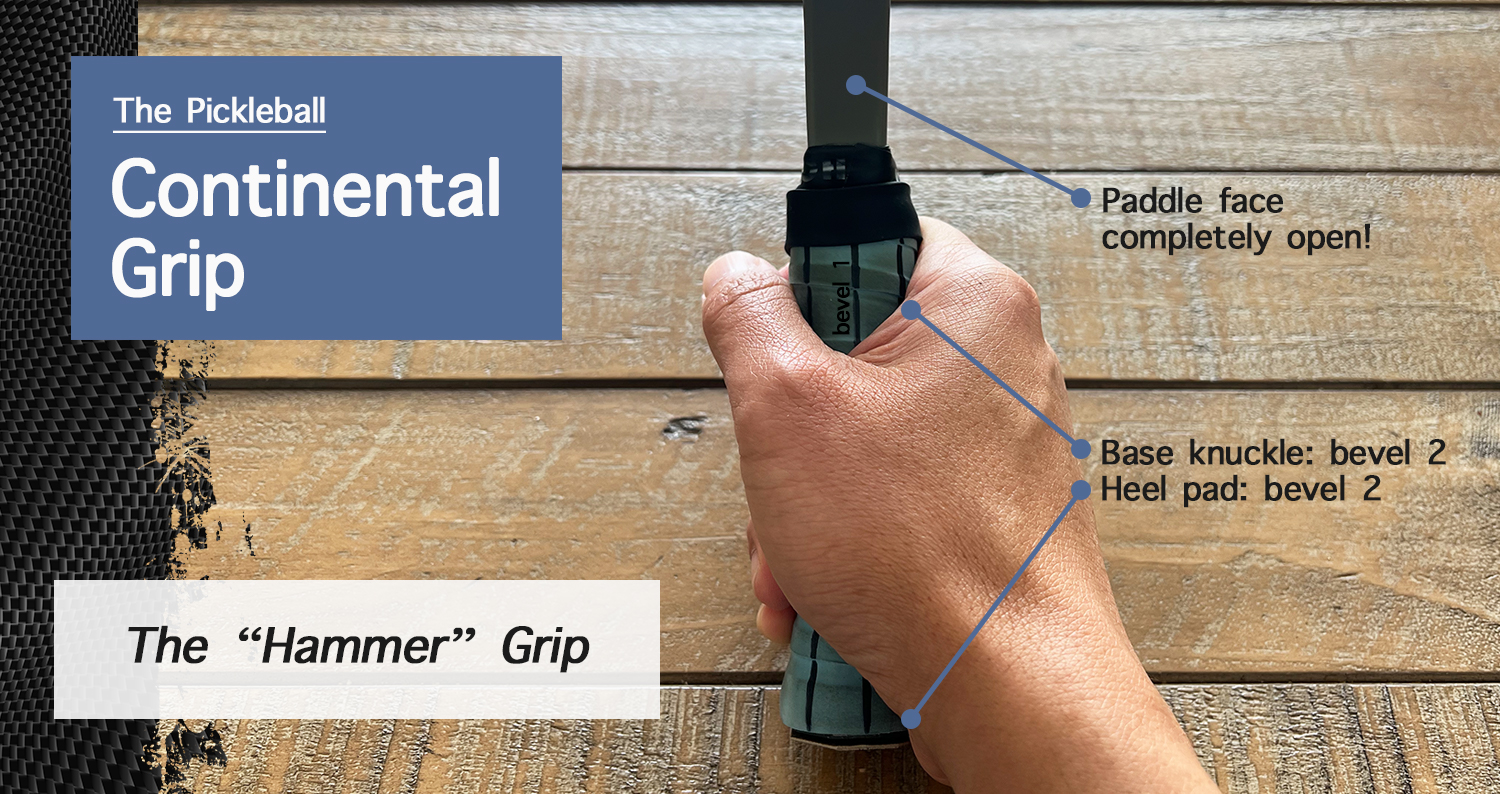
1. The Continental Grip (The “Hammer” Grip)
-
The Placement: Index knuckle and heel pad on Bevel 2. The “V” of your hand points directly down the center of Bevel 1.
-
The Feel: It feels exactly like holding a hammer to drive a nail into a wall.
-
Best Used For: Dinks, volleys, resets, and overheads at the non-volley zone (NVZ) line.
-
Pros & Cons: The absolute standard at the kitchen line. Because it keeps the paddle face neutral, you can hit both a forehand and a backhand volley without shifting your hand. The trade-off is that it makes generating extreme baseline topspin on drives highly difficult.
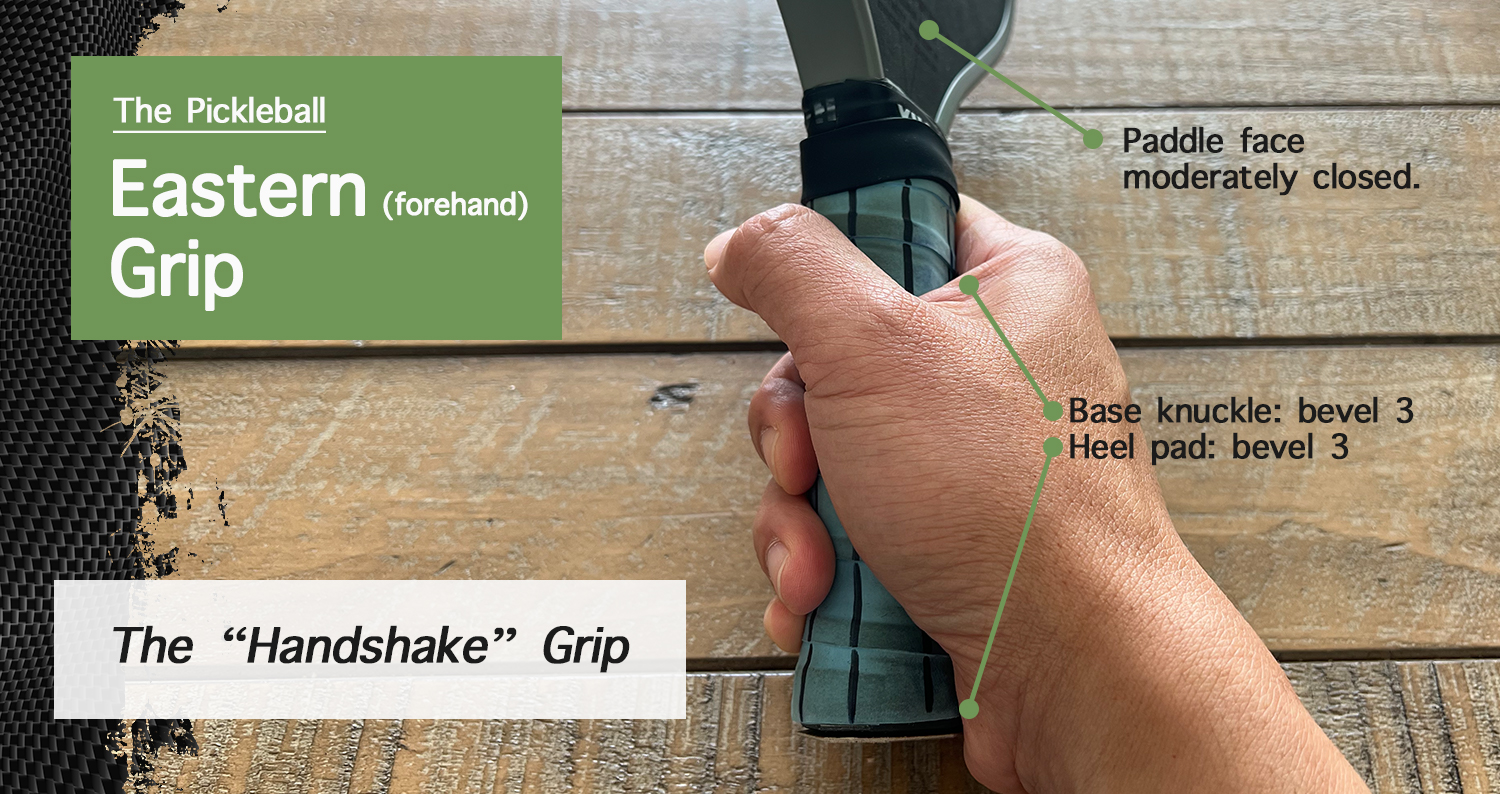
2. The Eastern Grip (The “Handshake” Grip)
-
The Placement: Index knuckle and heel pad on Bevel 3.
-
The Feel: Place your open palm flat against the paddle face, slide it down to the handle, and close your fingers as if shaking hands with the paddle.
-
Best Used For: Driving power and modern topspin from the baseline or transition zone.
-
Pros & Cons: It sits squarely behind the paddle, offering clean power and effortless access to moderate topspin on the forehand. However, it closes the paddle face on the backhand side, requiring a conscious wrist adjustment or grip shift to hit a backhand cleanly without popping the ball up.
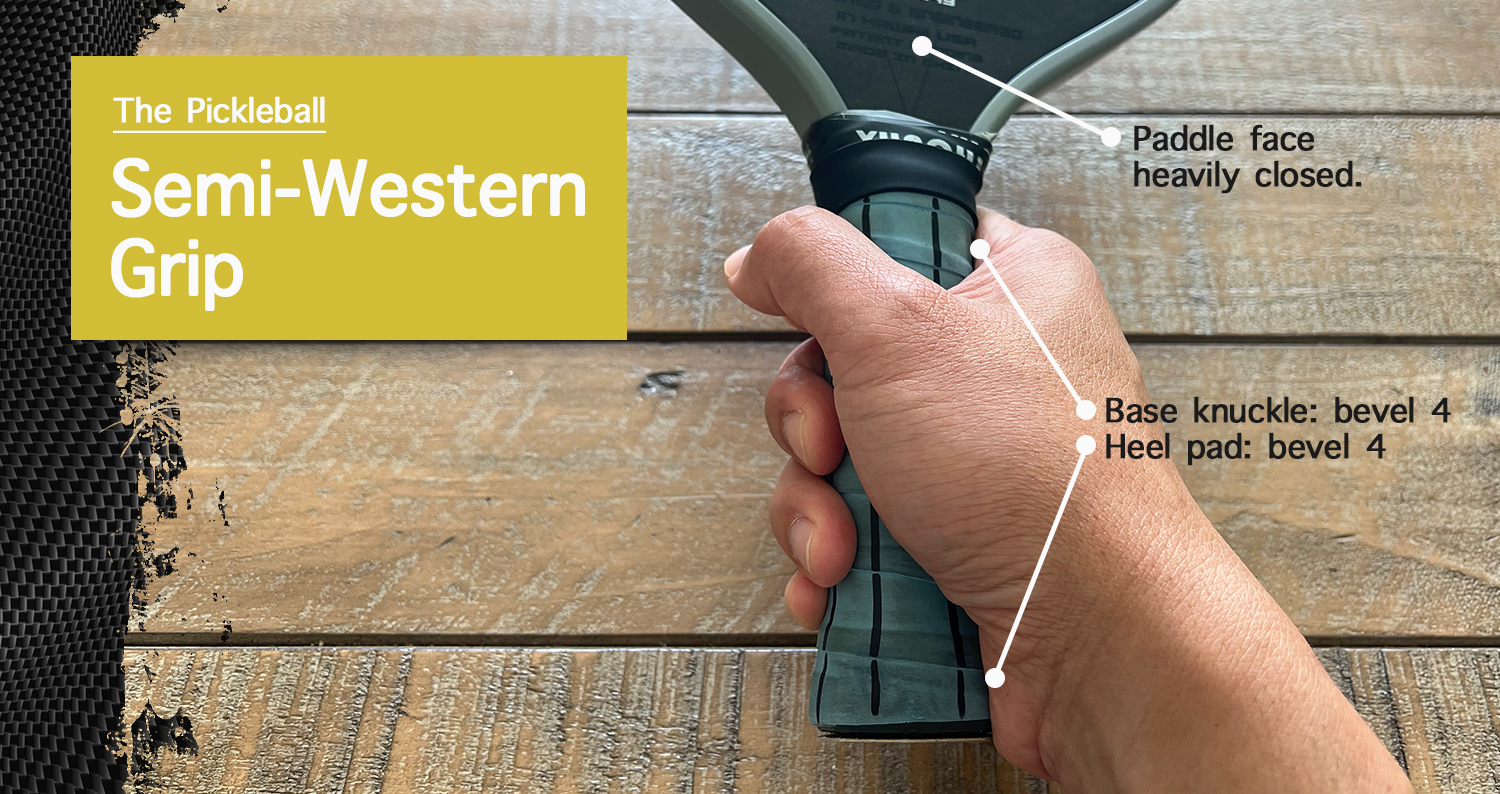
3. The Semi-Western Grip
-
The Placement: Index knuckle and heel pad on Bevel 4.
-
The Feel: Your hand shifts significantly underneath the handle.
-
Best Used For: Aggressive, heavy topspin baseline drives.
-
Pros & Cons: It naturally forces a low-to-high swing path, making the ball dip viciously over the net. The major downside is that a comfortable, standard one-handed backhand is almost mechanically impossible from this position.
4. The Western Grip (The “Frying Pan” Grip)
-
The Placement: Index knuckle and heel pad on Bevel 5.
-
The Feel: Your palm sits entirely underneath the bottom of the handle, as if you are holding a frying pan to flip a pancake.
-
Best Used For: Extreme, specialized topspin groundstrokes.
-
Pros & Cons: It yields the highest possible revolutions of topspin on the forehand side. However, it is exceptionally rare among advanced players because it leaves you highly vulnerable to fast, defensive backhand volleys at the kitchen line.
5. The Eastern Backhand Grip
-
The Placement: Index knuckle and heel pad on Bevel 1 (or Bevel 8).
-
The Feel: Counter-rotated to the left (for right-handers) so that your knuckles face forward toward the net.
-
Best Used For: Driving a powerful, aggressive one-handed backhand from the baseline.
-
Pros & Cons: It provides great structural stability and natural topspin leverage for backhand drives. However, you must switch out of it immediately if the ball comes to your forehand side.
Advanced Variations: The Two-Handed Backhand & The Panhandle
The Two-Handed Backhand Grip
As the pro game has speeded up, the two-handed backhand has exploded in popularity for its stability against hard-driving opponents. To execute it:
-
Your dominant hand sits at the bottom of the handle in a standard Continental grip (Bevel 2).
-
Your non-dominant hand is placed directly above it, wrapping around in a mirror-image Eastern Forehand grip (Bevel 3 for the top hand).
This hybrid layout grants immense stability, added reach, and the ability to roll over the top of the ball for heavy backhand topspin.
The Panhandle Warning
A common mistake among casual players is using a “Panhandle” grip—holding the paddle face completely flat to the net while the fingers wrap straight around the handle. While this feels comforting initially because it mimics a flyswatter, it locks the wrist, destroys your soft dinking touch, and makes hitting a backhand volley structurally impossible. Avoid this habit early.
Which Grip Is Best for Beginners?
For 90% of new players, the Continental grip is the ideal starting point.
Pickleball is a game of lightning-fast reaction times at the kitchen line. Beginners already have to focus on footwork, ball tracking, and court boundaries—adding a mid-rally grip change to that mental load causes hesitation. Because the Continental grip handles both forehand and backhand volleys seamlessly from a neutral position, it builds a rock-solid fundamental base.
The One Exception: Players entering pickleball with an established tennis background often carry a deeply grooved Eastern forehand grip. If this is you, it is perfectly acceptable to leverage that muscle memory for your baseline groundstrokes, provided you deliberately practice transitioning back to Continental as you move up to the kitchen line.
Why Grip Pressure and Mechanics Prevent Injury
Getting your grip right isn’t just about winning points; it’s about physical longevity. “Pickleball Elbow” (lateral epicondylitis) is a frequent issue in recreational play, and it is almost always caused by improper grip mechanics.
The 1-to-10 Pressure Rule
On a scale from 1 (the paddle is slipping out of your hand) to 10 (a white-knuckle squeeze), your default grip pressure should sit at a 3 or 4.
-
A loose grip acts like a shock absorber, absorbing the pace of incoming balls to hit soft, controlled dinks and defensive resets.
-
A tight grip (7 or above) stiffens the wrist, causing ball deflections to fly deep out of bounds, while transmitting all the kinetic shock of the ball straight up into your elbow joint.
Avoid the “Finger on the Paddle Face” Habit
Many beginners naturally extend their index finger completely straight up the back of the paddle face to “stabilize” their shots. This is a highly dangerous structural error. It severely limits your wrist mobility, completely exposes your index finger to bone fractures from fast incoming balls, and places intense, uneven leverage on the tendons in your forearm—setting you up for early-season tendonitis. Keep all your fingers safely wrapped around the handle.
Frequently Asked Questions
What is the most versatile grip in pickleball?
The Continental grip is the most versatile. It is considered the true “neutral” grip because it allows you to defend, block, dink, and volley on both sides of your body without ever moving your hand on the handle.
Do I need to switch grips during a point?
As you progress to intermediate and advanced levels (3.5+), yes. Many players shift to an Eastern or Semi-Western grip when driving from the baseline to generate spin, and instantly shift back to a neutral Continental grip as they split-step and approach the non-volley zone.
How tight should I squeeze the paddle handle?
Keep it light—roughly a 3 out of 10. Squeeze just tight enough that the paddle does not twist in your hand upon contact. A relaxed hand yields soft touch and fast hands.
Can I hit topspin with a Continental grip?
Yes, but it requires more intentional low-to-high shoulder and forearm lifting mechanics. Grips like the Eastern or Semi-Western naturally close the paddle face, making topspin a byproduct of a natural forward swing.
Next Posts
Continental Grip in Pickleball
Continental grip pickleball explained — exact knuckle placement, wrist angle at contact, and which shots it serves best and worst.
Eastern Grip in Pickleball
The Eastern grip in pickleball explained with exact hand placement, what it does to your wrist at contact, and where it outperforms Continental.
Semi-Western Grip in Pickleball
The Semi-Western grip explained — exact bevel placement between Eastern and Western, the topspin it unlocks, and the backhand cost.
continue reading
Related Posts
Pickleball sliding practice explained — how a controlled slide spreads deceleration force over distance instead of one hard stop, and how to train it off-court.
Wide stance deceleration in pickleball explained — why sudden stops stress the knees and ankles, and how a wider base distributes that force safely.
Pickleball lob footwork explained step by step — the pivot, drop step, and shuffle or crossover run that replaces backpedaling for any lob.