
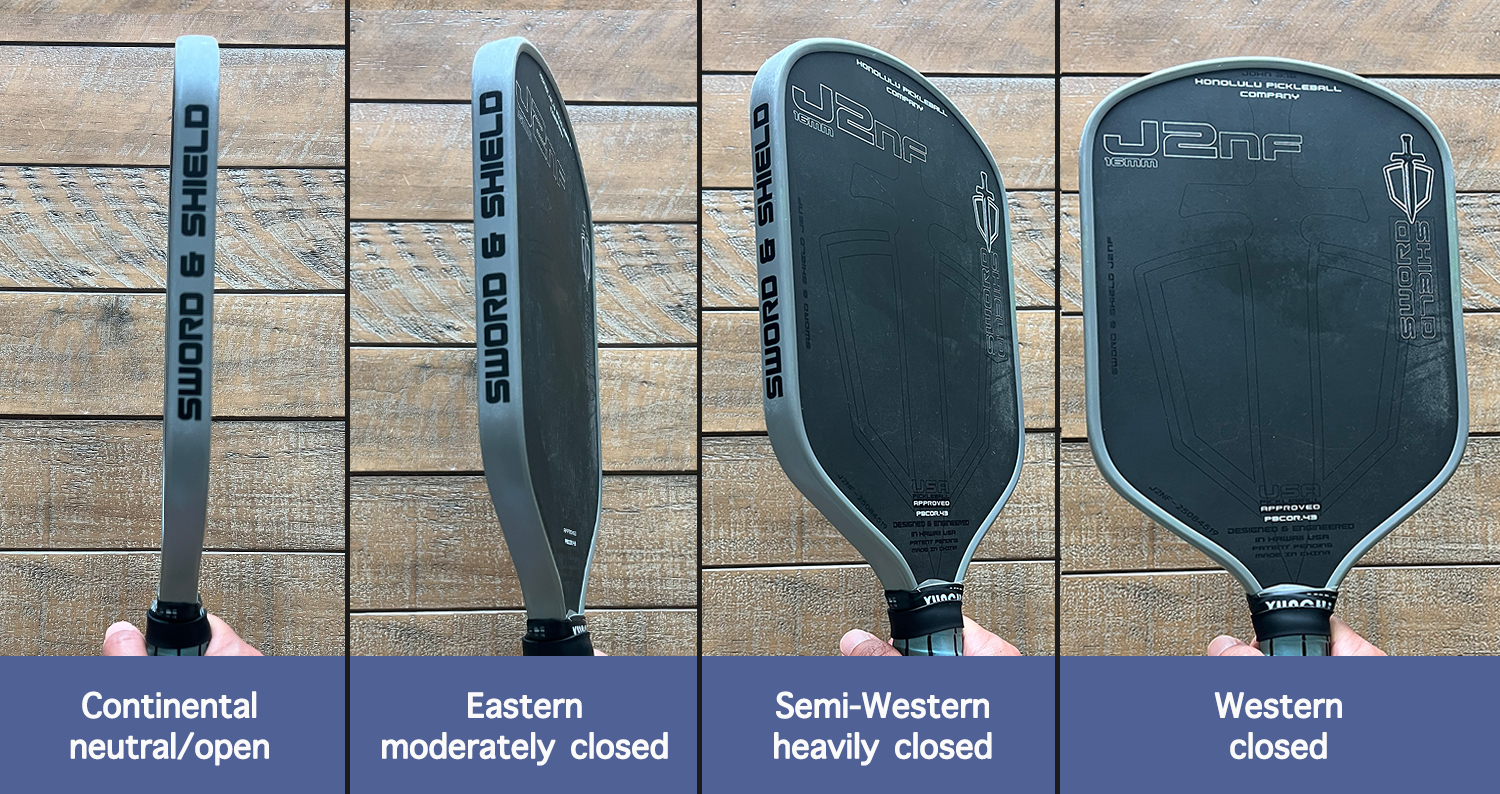
Choosing a pickleball grip style is not about copying a touring pro’s highlight reel—it is a calculation of court geometry, ball height, and tactical movement. Your grip choice dictates your paddle face angle at impact, governs your fast-twitch hand speed at the net, and protects your joints from chronic injury.
If you have followed our individual grip profile guides, you already know the technical parameters of the major options: the Continental, Eastern, Semi-Western, Western, and specialized Eastern Backhand grips.
Now, it’s time to synthesize that information. Modern, high-level pickleball requires a dynamic approach. This master decision guide breaks down how to map out your technical strengths and, most importantly, how to execute the baseline-to-kitchen grip transition like the pros.
The Crucial Concept: The Dynamic Grip Shift
The single biggest secret to advanced pickleball is recognizing that your grip should change depending on where you stand on the court. While beginners should master a single neutral grip to build baseline consistency, advanced players use a highly fluid, dual-zone system:
The Advanced Playbook: Use an Eastern or Semi-Western grip at the baseline to hit aggressive, high-arcing topspin serves and heavy dipping drives. As you move through the transition zone and establish yourself at the Non-Volley Zone (NVZ) line, slide your hand back to a neutral Continental grip to defend against rapid-fire body speed-ups.
Quick Summary of Court Styles
-
The “Pure Kitchen” Default (Rec Doubles Standard): Continental. If you rarely leave the net, its neutral geometry requires zero grip shifts when transitioning from a forehand volley to a backhand volley under fire.
-
The Dynamic All-Courter: Eastern or Semi-Western at the baseline for devastating forehand shapes, actively spinning the paddle into Continental at the net.
-
Tennis Background + One-Handed Backhand: Eastern Forehand, paired with an active, mid-rally unit-turn shift to an Eastern Backhand when targeted on your left side.
-
Tennis Background + Two-Handed Backhand: Continental on your dominant hand (bottom), paired with an Eastern Forehand placement on your non-dominant hand (top) to act as the primary accelerator.
How to Decide: Your 4-Step Self-Diagnostic Guide
To find your baseline home base and map out your transition game, run through this four-step diagnostic sequence:
Step 1. Estimate Your Positional Court Split [Court Position]
Track your average points. Are you spending rallies scraping drives from the baseline, or are you locked in at the net?
-
If you play heavy recreational doubles and spend 70% or more of your time at the NVZ, prioritize mastering the neutral, zero-friction properties of the Continental grip first.
-
If you play high-velocity singles or act as an aggressive third-shot driver, you must learn to load up in an Eastern or Semi-Western grip at the back of the court to stay competitive.
Step 2. Honor Your Racquet Sport History [Racquet Sport History]
Do not force your nervous system to override years of hardwired muscle memory:
-
Former Tennis One-Handers: Excel with an Eastern Forehand-to-Backhand rotational matrix.
-
Modern Tennis Two-Handers: Stick to a Continental bottom hand and let your stacked top hand drive the ball.
-
Table Tennis Veterans: Slide naturally into Continental to comfortably utilize your native wrist-flick adjustments and open-face resets.
Step 3. Select Your Performance Priority [Power vs. Versatility]
Determine your tactical identity on the court:
-
If your ultimate goal from the baseline is to drop the paddle head and hit a low-to-high “windshield-wiper” arc that sends heavy topspin diving down at your opponent’s feet, choose Semi-Western.
-
If you value unshakeable net defense, quick reflex blocks, and feather-touch dinks, keep your default home base at Continental.
Step 4. Run the Mirror Test [Hand / Paddle Face]
Stand in front of a mirror or step into your default ready stance on the court. Hold your paddle directly out in front of you in your preferred net grip. Imagine an opponent firing a 60 mph body-smash directly at your chest.
Without spinning or adjusting the handle in your hand, can you cleanly present a flat, stable blocking surface on both your forehand and backhand sides? If your baseline grip completely blocks out your backhand at the net, you must learn to shift to Continental when approaching the kitchen.
The Biomechanics: Why Your Selection Compounds Over Time
Your grip selection is not merely a tactical choice; it is an orthopedic insurance policy. This decision ultimately comes down to matching your grip style to your wrist’s natural, comfortable working range under the specific high-volume shots you execute most frequently.
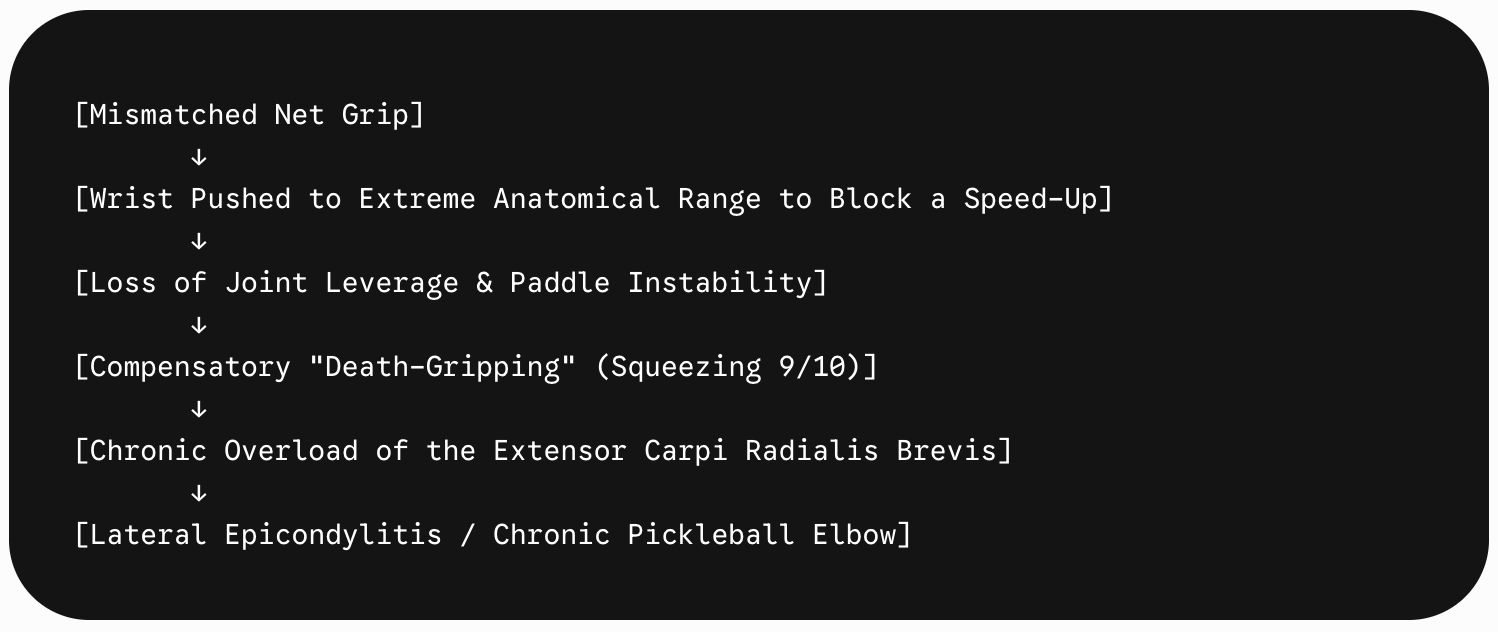
When an aggressive baseline grip (like Semi-Western or Western) is kept at the net during rapid exchanges, the wrist joint operates at its absolute structural limit to try and square the paddle face. Because the hand cannot naturally present a flat blocking surface from this position, the player compensates by squeezing the handle with excessive force.
As detailed in our Continental profile, proper touch requires the 3-to-7 Pressure Rule (gripping at a loose 3 out of 10 at rest, ramping to a 7 only at the fractional millisecond of contact). Keeping a constant “death-grip” to force stability transfers the ball’s impact shock directly up the kinetic chain into the extensor tendon compartment. Over a long season of thousands of impacts, this chronic microtrauma leads directly to lateral epicondylitis (pickleball elbow) and TFCC wrist strain.
Body Positions by Importance
| Body Part | Why It Matters | What Happens If It’s Wrong |
|---|---|---|
| 1. Wrist | The mechanical anchor. Must sit within an unforced, neutral range at impact to distribute contact force evenly. | Forces acute hyperextension or hyperflexion, causing immediate power leaks and tendon fatigue. |
| 2. Elbow | Acts as the primary shock-absorber when the wrist is mechanically compromised by an extreme grip angle. | Becomes the focal point for chronic overuse injuries, resulting in debilitating lateral epicondylitis. |
| 3. Hand (Bevel Position) | The physical blueprint that dictates your native muscle memory and repeatable paddle face angles. | Grip drift or mid-rally hand slipping prevents your strokes from feeling automatic under pressure. |
| 4. Non-Dominant Hand | The mandatory stabilizer and throttle control for all modern two-handed backhand configurations. | Essential for executing the Off-Hand Throttle Twist to safely transition between grips mid-rally. |
Common Strategic Mistakes & The Tactical Fixes
-
Mistake: Camping out in an aggressive baseline grip at the kitchen line.
-
The Penalty: Keeping your hand turned completely under the handle (like a Semi-Western or Western) during fast net volleys drops the paddle face down, causing your volleys to dump directly into the net tape or pop up wildly.
-
The Fix: Master the Off-Hand Throttle Twist. As you move up the transition zone toward the kitchen, use your non-dominant hand at the paddle’s throat to physically spin the handle back into a neutral Continental setting.
-
-
Mistake: Selecting a grip based on a pro’s social media highlight reel.
-
The Penalty: Ignores your personal hand anatomy, physical flexibility, and structural sport background.
-
The Fix: Always run the Mirror Test to establish your own native hand-to-paddle geometry before copying advanced players.
-
-
Mistake: Treating your grip choice as a permanent, lifetime decision.
-
The Penalty: Restricts your physical development as your tactical identity shifts toward more calculated net play or heavy baseline driving.
-
The Fix: Formally audit your hand alignment every few months. Re-test alternative setups during practice drills to ensure your mechanics match your tactical evolution.
-
Frequently Asked Questions
Should beginners try to switch grips mid-rally?
Generally, no. Beginners should stick to a single versatile grip—ideally Continental or a mild Eastern—across the entire court. Introducing mid-rally grip changes too early can lead to mishits and cognitive overload. Save the baseline-to-kitchen grip shift for when your footwork and tracking mechanics become second nature.
Will changing my grip ruin the muscle memory I’ve already built?
Expect a brief calibration window of 3 to 5 focused drilling sessions where your contact may feel slightly inconsistent. Your brain has calibrated your swing path to a specific paddle face angle. Shifting your hand to a new configuration will alter that angle at impact. Once your mind realigns the new hand-to-face geometry, your consistency will return.
Is there one specific pickleball grip that is objectively the best overall?
No. While the Continental grip is the most versatile, safe, and balanced default for net play and doubles defense, versatility is not the same as being optimal for every individual stroke. The ideal grip strategy depends entirely on where you stand on the court and how dynamically you can transition between positions.
Next Posts
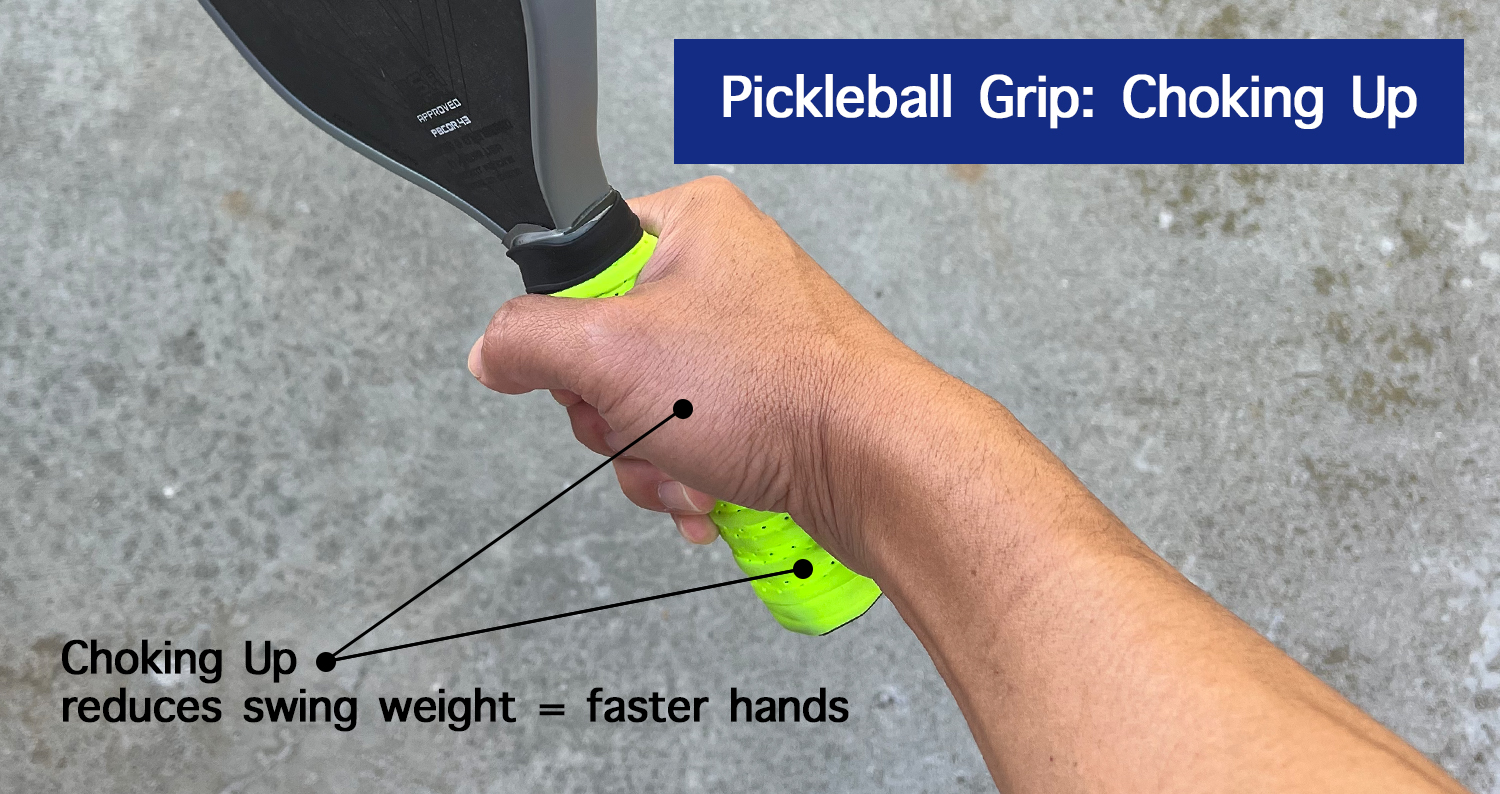
Choking Up on Your Pickleball Grip
Choking up on your pickleball grip explained — why pros hold the handle differently at the baseline versus the kitchen, and how it changes swing weight.
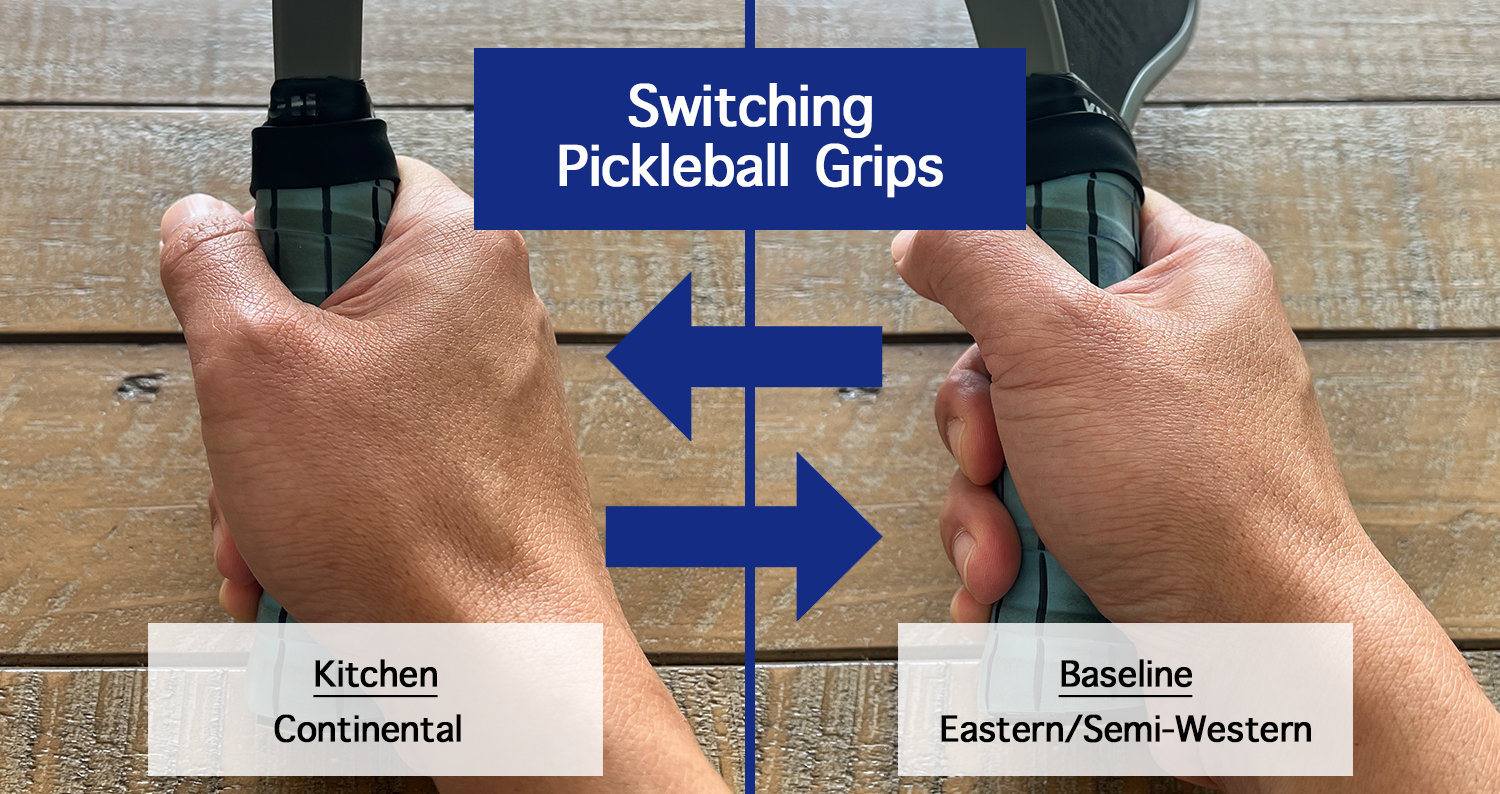
Switching Pickleball Grips
Switching pickleball grips between baseline power and kitchen neutrality, explained with the exact timing pros use to keep it fast and unnoticed.
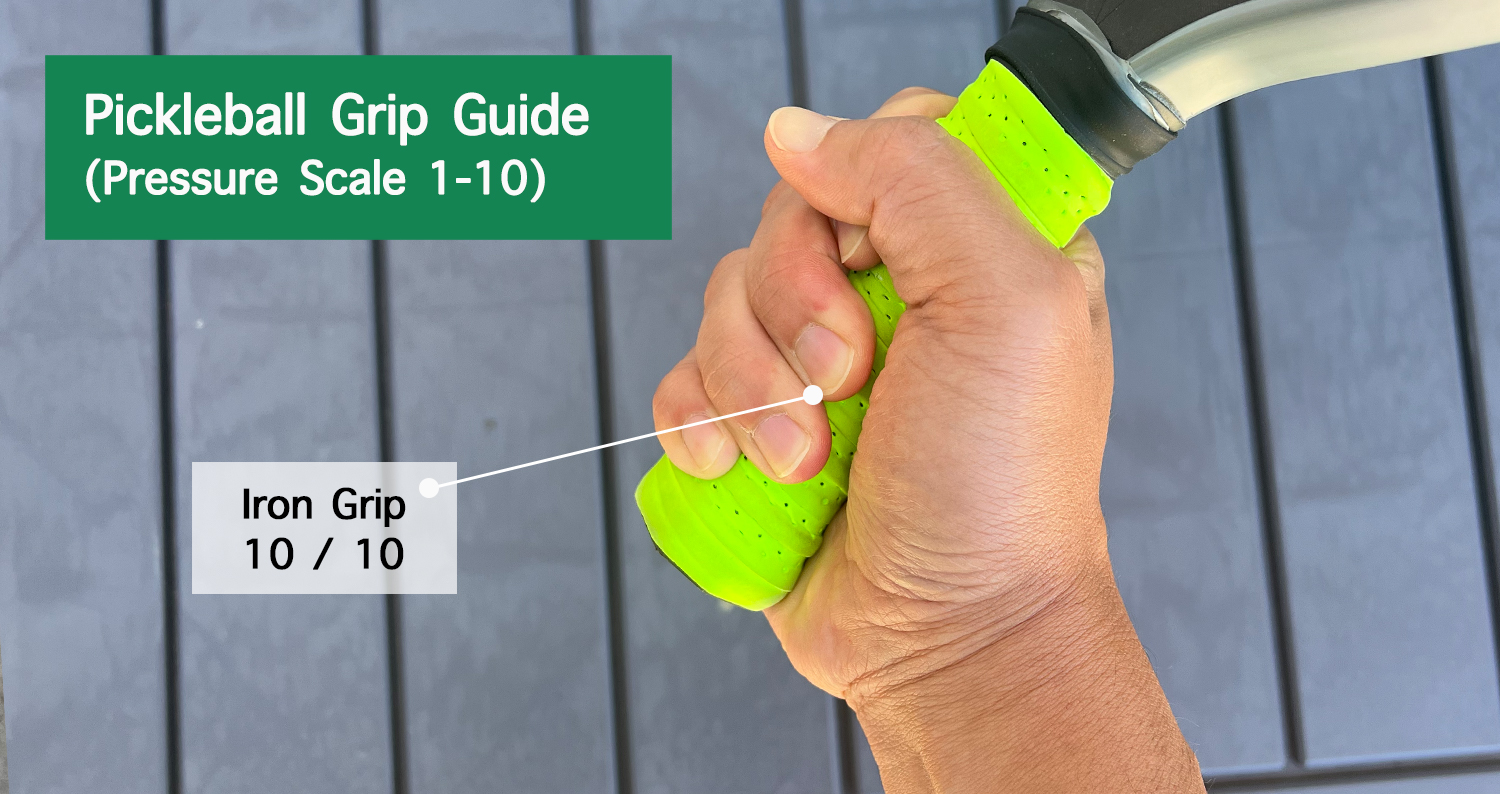
Pickleball Grip Pressure: The 1-to-10 Scale Explained
Pickleball grip pressure explained using the 1-to-10 scale coaches use — exact pressure targets by shot type and why tight grips cause pop-ups.
continue reading
Related Posts
Pickleball sliding practice explained — how a controlled slide spreads deceleration force over distance instead of one hard stop, and how to train it off-court.
Wide stance deceleration in pickleball explained — why sudden stops stress the knees and ankles, and how a wider base distributes that force safely.
Pickleball lob footwork explained step by step — the pivot, drop step, and shuffle or crossover run that replaces backpedaling for any lob.